Professional circular saw bladesFreud

LU2A

Saw blades for wood-based panels ripping and crosscutting

A 40-code Freud family for ripping and crosscutting wood-based panels, from 150 to 760 mm, for squaring saws, horizontal panel sizing saws and hand-held circular saws.

Ø 150–760 mm Z 18–96 Bore 20–80 mm
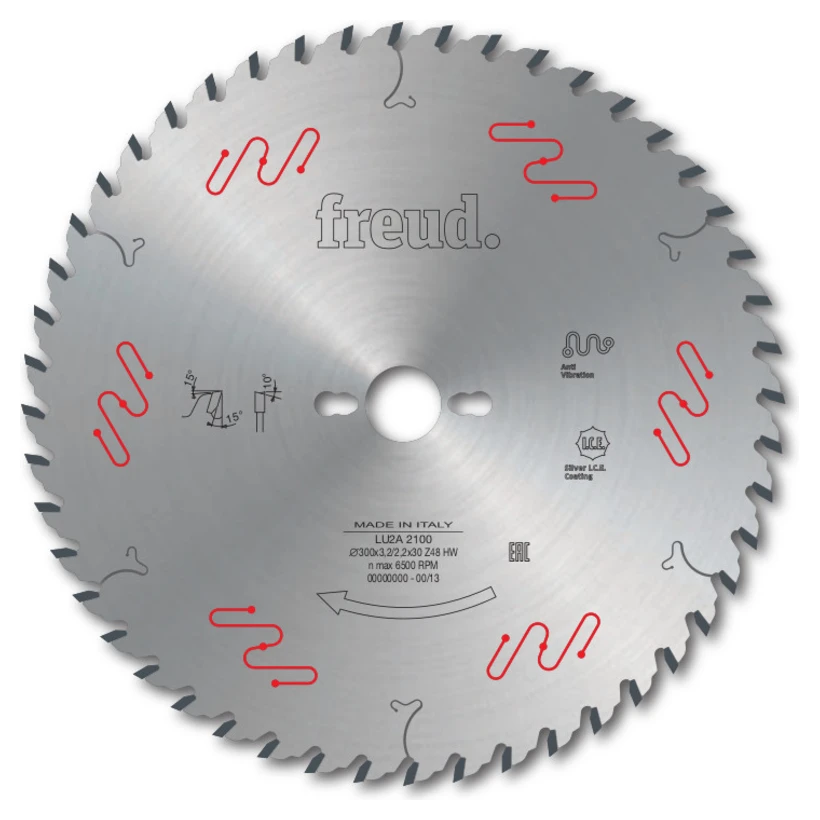
Ref · LU2A 40 codes Freud LU2A circular saw blade for ripping and crosscutting wood-based panels
Machines
Squaring saws, Hand-held circular saws, Horizontal panel sizing saws
Materials
Softwood, Hardwood, MDF, Chipboard, Plywood
Applications
Ripping, Crosscutting
Range
40 verified codes

Application

When to choose LU2A

LU2A is the broad universal family for panels: 40 configurations with 150–760 mm diameters, 20–80 mm bores and 18–96 teeth. Alternative tooth counts at many diameters allow cutting quality and feed rate to be balanced without changing family.

Application
Ripping
Excellent
Application
Crosscutting
Eccellente
Material
Softwood
Suitable
Material
Hardwood
Suitable
Material
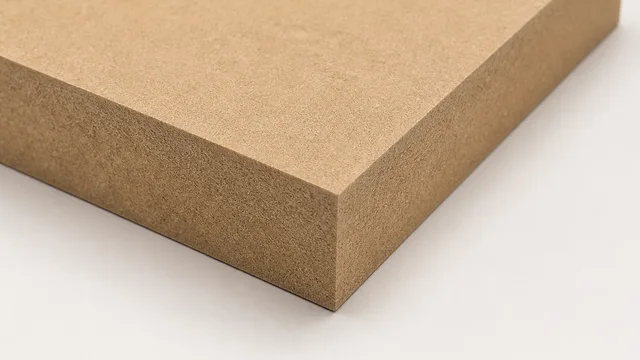
MDF
Suitable
Material
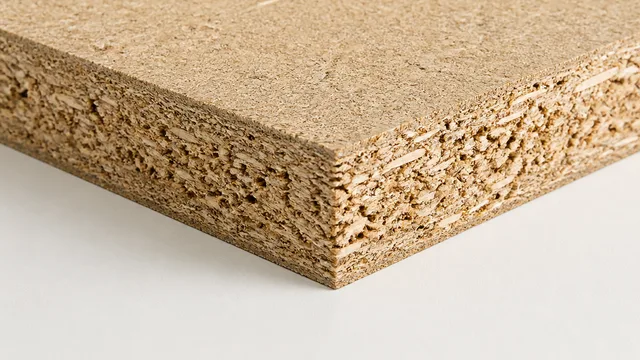
Chipboard
Suitable
Material
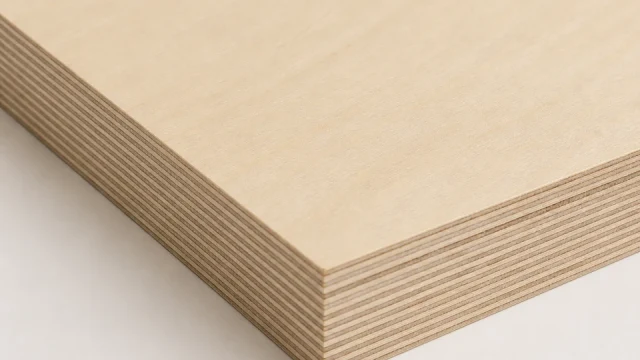
Plywood
Suitable

Technical note

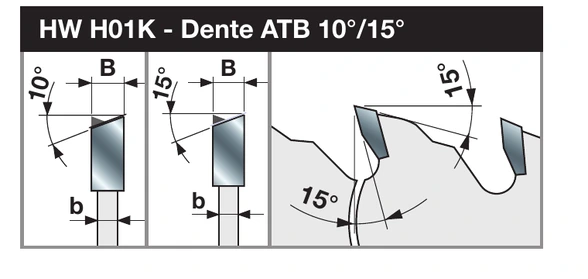
H01K carbide across most of the range; the 735 and 760 mm variants use K10S. ATB geometry with a 10° or 15° bevel according to code and a positive 15° hook angle. Blades from 230 mm have anti-vibration slots. Always check FT01 or FT02 pin-hole patterns against the flange.

Compatibility at a glance

Machines and materials

01 Compatible machines

Squaring saws
Squaring saws
Hand-held circular saws
Horizontal panel sizing saws

02 Suitable materials

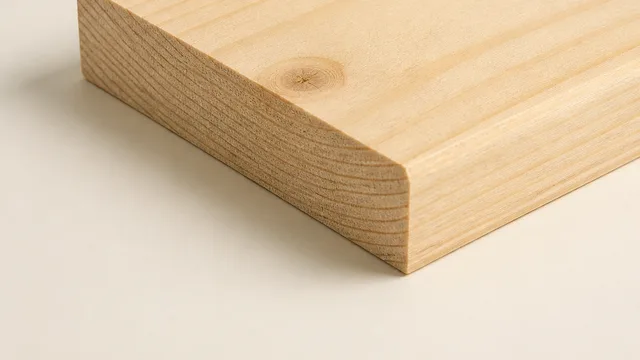
softwood sample
Softwood Legno massiccio
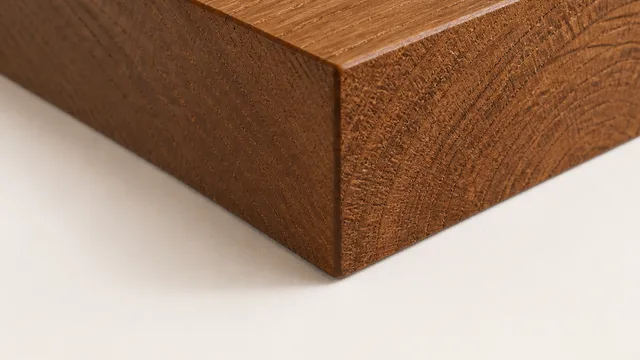
hardwood sample
Hardwood Legno massiccio
mdf sample
MDF Pannello a base legno
chipboard sample
Chipboard Pannello a base legno
plywood sample
Plywood Pannello di legno

Always check the pin-hole pattern

Technical configuration

Tooth geometry and technologies

Shared family specifications, kept separate from the dimensions of each individual code.

HW H01K 10/15°
ATB 10°/15° tooth geometry

ATB

H01K carbide, 10° or 15° ATB geometry according to code, and positive 15° hook angle.

TiCo Carbide

Specially formulated carbide tips for durability and cutting quality.

Silver I.C.E.

Coating designed to reduce friction, heat and material build-up.

Anti-vibration

Technology designed to reduce vibration and noise.

Operating parameters

Diameter, RPM and cutting height

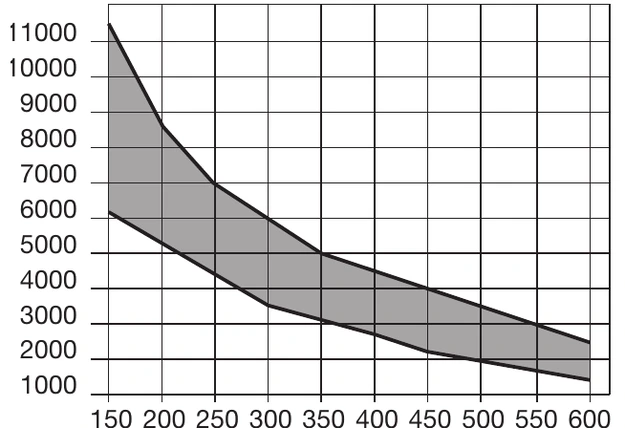
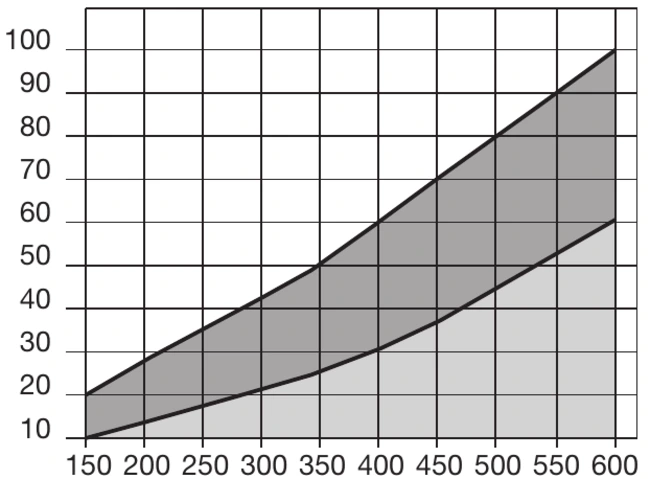
The charts show how the recommended speed and cutting capacity change across the LU2A range.

Rotational speed LU2A
Revolutions per minuteDiameter (mm)

Rotational speed

The recommended RPM range decreases as blade diameter increases.

The actual speed must remain within the limits of both the blade and the machine.

Cutting capacity LU2A
Cutting height (mm)Diameter (mm)

Cutting capacity

Maximum cutting height increases with blade diameter.

This is a family-level reference; actual clearance and capacity also depend on the machine.

Essential check: before fitting the blade, check its diameter, bore, pin-hole pattern, direction of rotation and the maximum RPM marked on the blade.

Dimensional selector

Find the correct product code

Filter the variants by the two key dimensions, then compare kerf, plate thickness, tooth count and pin-hole patterns.

40 variants found

D diameterB kerfb plate thickness d boreZ teeth NL / KN pin holes and keyways
CodeØ mmKerf BPlate bBore dTeeth Z NL / KN Tooth Article no.
LU2A0100 150 3.2 2.2 30 24 2/7/42 ATB 10° F03FS04806
LU2A0200 160 3.2 2.2 20 18 2/6/32 ATB 15° F03FS04808
LU2A0300 160 3.2 2.2 20 24 2/6/32 ATB 10° F03FS04809
LU2A0301 160 2.2 1.6 20 24 ATB 15° F03FS09233
LU2A0400 180 3.2 2.2 20 24 2/6/32 ATB 10° F03FS04810
LU2A0500 180 3.2 2.2 30 30 2/7/42 ATB 10° F03FS04811
LU2A0600 190 3.2 2.2 30 30 2/7/42 ATB 10° F03FS04813
LU2A0700 200 3.2 2.2 30 24 2/7/42 ATB 15° F03FS04814
LU2A0800 200 3.2 2.2 30 34 2/7/42 ATB 10° F03FS04817
LU2A0900 200 3.2 2.2 35 34 ATB 10° F03FS04819
LU2A1000 210 3.2 2.2 30 24 2/7/42 ATB 15° F03FS04821
LU2A1100 210 3.2 2.2 30 34 2/7/42 ATB 10° F03FS04822
LU2A1200 216 3.2 2.2 30 34 ATB 10° F03FS04823
LU2A1300 220 3.2 2.2 30 34 2/7/42 ATB 10° F03FS04824
LU2A1400 230 3.2 2.2 30 24 2/7/42 ATB 15° F03FS04826
LU2A1500 230 3.2 2.2 30 34 2/7/42 ATB 10° F03FS04827
LU2A1600 250 3.2 2.2 30 30 FT01 ATB 10° F03FS04828
LU2A1700 250 3.2 2.2 30 40 FT01 ATB 10° F03FS04830
LU2A1800 250 3.2 2.2 35 40 ATB 10° F03FS04832
LU2A1880 250 3.2 2.2 80 40 ATB 10° F03FS09971
LU2A1900 300 3.2 2.2 30 36 FT01 ATB 10° F03FS04834
LU2A2100 300 3.2 2.2 30 48 FT01 ATB 10° F03FS04840
LU2A2300 300 3.2 2.2 35 48 ATB 10° F03FS04843
LU2A2400 315 3.2 2.2 30 48 FT01 ATB 10° F03FS04844
LU2A2500 350 3.5 2.5 30 42 FT02 ATB 15° F03FS04845
LU2A2600 350 3.5 2.5 35 42 ATB 15° F03FS04847
LU2A2800 350 3.5 2.5 30 54 FT02 ATB 10° F03FS04849
LU2A3000 350 3.5 2.5 35 54 ATB 10° F03FS04851
LU2A3100 400 4 2.8 30 48 2/10/60 ATB 15° F03FS04853
LU2A3150 400 4 2.8 50 48 6/5,5/80 + 1/6/80 ATB 15° F03FS09578
LU2A3300 400 4 2.8 30 60 2/10/60 ATB 10° F03FS04856
LU2A3400 400 4 2.8 35 60 ATB 10° F03FS04858
LU2A3500 450 4.4 3 30 54 2/10/60 ATB 10° F03FS04860
LU2A3600 450 4.4 3 30 66 2/10/60 ATB 10° F03FS04862
LU2A3700 500 4.4 3.2 30 60 2/10/60 + 2/10/80 ATB 15° F03FS04864
LU2A3800 500 4.4 3.2 30 72 2/10/60 + 2/10/80 ATB 10° F03FS04865
LU2A3900 550 4.8 3.5 30 84 2/10/60 + 2/10/80 ATB 10° F03FS04867
LU2A4000 600 5.4 4 30 96 2/10/80 ATB 10° F03FS04868
LU2A4200 735 6 4.4 30 72 2/8,5/90 ATB 10° F03FS05908
LU2A4300 760 6.2 4.5 30 72 2/8,5/90 ATB 10° F03FS05903
FT01 2/7/42 + 2/9/46,4 + 2/10/60 FT02 2/9/46,4 + 2/10/60

Before choosing

The blade family is only the first step

Once LU2A has been identified, the exact product code depends on the machine requirements. The portal keeps these two decisions separate.

  1. 1
    Check the machine

    Permitted diameter, bore and pin holes.

  2. 2
    Confirm the application

    Ripping / Crosscutting.

  3. 3
    Choose the variant

    Kerf, plate thickness and tooth count.

  4. 4
    Check the operating parameters

    Speed and cutting height according to the family charts.

Frequently asked questions

Questions about the LU2A family

Quick answers for checking the application, compatibility and operating parameters before selecting a product code.

01 What is the LU2A family designed for?

LU2A is designed for Ripping and Crosscutting. Its suitability must be checked against the material, machine and exact variant specifications.

02 Which materials can LU2A cut?

The family is specified for Softwood, Hardwood, MDF, Chipboard, Plywood. Material density, coating, thickness and condition can affect the resulting edge quality. For LU2A, verify the selected reference within its 150–760 mm diameter and 18–96-tooth range.

03 Which machines can use LU2A blades?

The catalogue specifies Squaring saws, Hand-held circular saws, Horizontal panel sizing saws. Before fitting, check diameter, bore, flange or pin-hole pattern and the permitted maximum speed. For LU2A, verify the selected reference within its 150–760 mm diameter and 18–96-tooth range.

04 What tooth geometry does LU2A use?

The family uses ATB 10° tooth geometry. Refer to the technical note for the carbide grade and hook angle. For LU2A, verify the selected reference within its 150–760 mm diameter and 18–96-tooth range.

05 How many LU2A variants are available?

There are 40 variants, with diameters from 150 to 760 mm, bores from 20 to 80 mm and tooth counts from 18 to 96. For LU2A, verify the selected reference within its 150–760 mm diameter and 18–96-tooth range.

06 How do I select the correct LU2A code?

For LU2A, start with the machine bore (20–80 mm) and the required diameter (150–760 mm). Then select within the available 18–96-tooth range by comparing kerf, plate thickness and any pin holes or keyways.

07 At what speed should a LU2A blade run?

The correct speed for an LU2A blade depends on the selected diameter, which ranges from 150 to 760 mm, and on the machine. Never exceed the lower of the maximum RPM marked on that blade and the machine manufacturer’s limit.

08 Can LU2A blades be resharpened?

A specialist can assess and resharpen the ATB carbide teeth used by LU2A, provided the blade body is undamaged. The original geometry, angles and balance must be preserved; the number of possible services depends on the condition of the selected reference.

Guides

Guides related to this blade family

The catalogue starts with the tool; the guides start with the cutting problem. If you are still choosing, read these first.
5 min read

Birch plywood: what it is and how to cut it cleanly

Birch plywood is often chosen for its exposed edge. That edge is also the hardest part to cut without splintering.

Open guide
5 min read

Chipboard: structure, cutting behaviour and blade selection

The most widespread and underestimated panel. Beneath the tooth it is heterogeneous and must be treated accordingly.

Open guide
6 min read

Circular saw blade diameter and bore: checking compatibility

Three checks on the machine, not one: maximum blade diameter, spindle bore and drive-pin pattern.

Open guide
7 min read

Circular saw blade technical glossary

The abbreviations used in technical tables, explained individually: dimensions, tooth geometries, mounting holes and blade-body technologies.

Open guide
4 min read

How to choose a blade for a sliding table saw

Eight machine checks to make before ordering, plus the question that changes the choice: is there a scoring blade?

Open guide
4 min read

How to choose a professional circular saw blade

The five specifications that narrow hundreds of product codes down to two or three, in the order in which they should be checked.

Open guide
6 min read

How to choose the tooth count for a circular saw blade

Why panel-saw blade families range from 18 to 168 teeth, and how to identify the right part of that range for your task.

Open guide
6 min read

MDF: structure, cutting behaviour and blade selection

One of the most predictable panels in the cut and one of the most demanding on the cutting edge. Its manufacture explains why.

Open guide
3 min read

Maximum rpm for a circular saw blade

Maximum rpm is based on peripheral speed, not an arbitrary table. Some blade families have much lower specific limits.

Open guide
4 min read

Ripping vs crosscutting: differences and blade choice

The same board behaves like two different materials depending on the direction of cut. Here is how tooth count, hook angle and feed change.

Open guide
5 min read

Saw blade tooth geometries: ATB, TCG, DTCG and flat top

Four profiles and four different ways of entering the material: how to recognise them and when each becomes the necessary choice.

Open guide
6 min read

Solid wood: grain direction and circular saw blade selection

The one catalogue material in which cutting direction changes everything. Before choosing a blade, determine the direction of the grain.

Open guide
5 min read

Which blade for MDF, plywood and chipboard?

Three panels that appear to need the same blade but stress the cutting edge in three different ways.

Open guide