Blade selection
Saw blade tooth geometries: ATB, TCG, DTCG and flat top
At a glance
ATB uses an inclined cutting edge to sever fibres and is the reference geometry for wood and panels. TCG alternates a trapezoidal tooth with a flat tooth and suits hard or abrasive materials. A flat-top tooth removes material efficiently when finish is secondary. DTCG extends the trapezoidal principle for demanding materials such as steel.
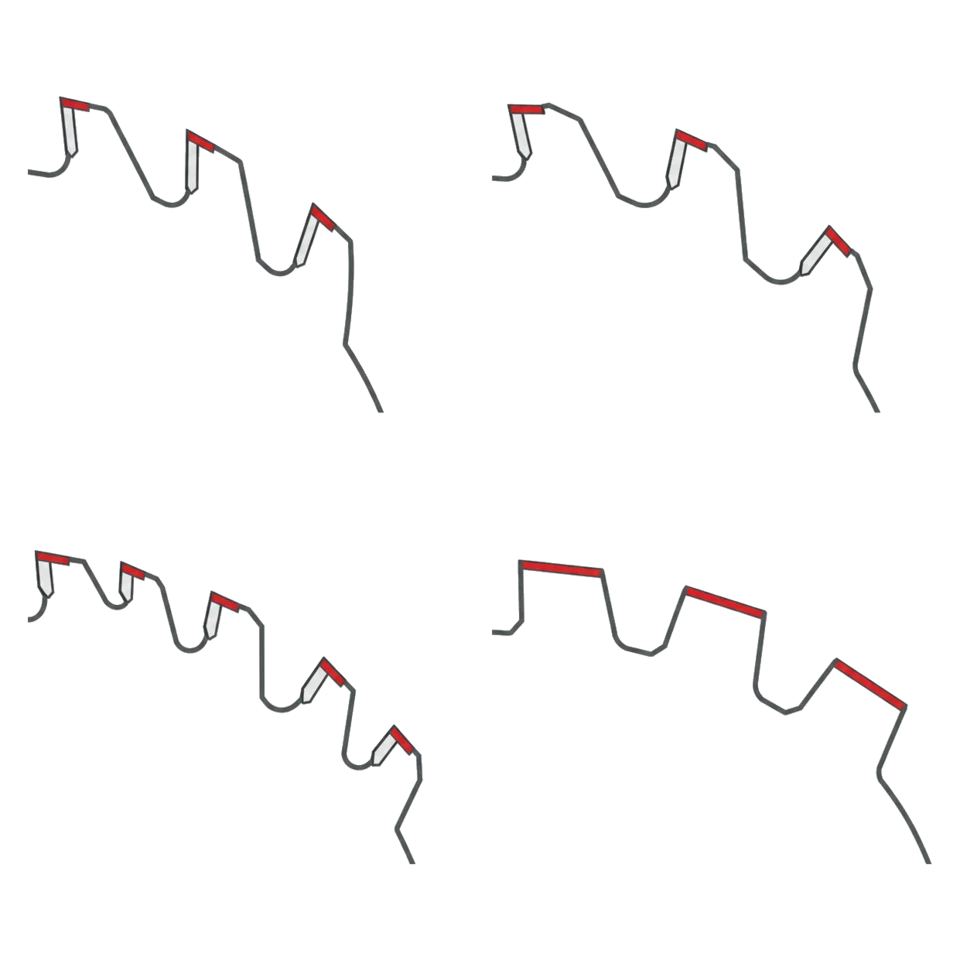
The profile determines how the tooth enters the material
Before looking at how many teeth a blade has, examine the individual tooth. Cutting-edge shape determines where first contact occurs, which in turn affects whether fibres are severed progressively or torn away.
An inclined edge contacts the workpiece at one corner and cuts progressively, rather like a knife. A flat edge contacts across its full width and pushes straight through: it removes material efficiently but leaves a different exit edge.
Hook angle adds another variable. Across the catalogue it ranges from +15° on some panel blades to −6° on blades for thick laminated panels and non-ferrous metals. A positive angle pulls into the cut; a negative angle directs more force down towards the machine table.
Four tooth geometries compared
| Geometry | How it cuts | Where it is appropriate | Limitation |
|---|---|---|---|
| ATB | Alternating bevels to left and right sever surface fibres first | Solid wood, raw and faced panels, crosscutting | Sharp corners wear faster in abrasive materials |
| TCG (triple-chip grind) | A trapezoidal tooth roughs the cut and a following flat tooth clears the bottom | Laminates, HPL, plastics and non-ferrous metals | Offers no advantage for ripping solid wood and cuts more slowly |
| Flat top | Straight cutting edge with frontal material removal | Ripping, gang cutting and a square-bottomed cut | A more pronounced exit edge when crosscutting |
| DTCG (double trapezoidal) | Trapezoidal form on both faces distributes load over several edges | Dry cutting steel and abrasive polymer materials | Requires low speed and a suitable machine |
These abbreviations describe tooth profile, not quality. The same geometry can use different carbide grades, bevels and hook angles.
ATB: the reference geometry for wood
ATB is the most widespread wood geometry because the key task is to sever fibres before lifting them. The leading corner of the bevel does exactly that.
The bevel and hook angle vary by application. LU2A uses a 10° or 15° bevel depending on the product code with a positive 15° hook angle. Crosscut-only LU2C uses a 15° bevel but a much less aggressive positive 5° hook angle and therefore requires a more controlled feed.
Profile and moulding blades can use a steeper bevel. LU1I combines ATB 20° with a 10° hook angle for painted or coated surfaces where edge chipping cannot be repaired. At 300 mm it is available as Z96 and Z112: tooth counts that would be excessive on a thick panel but appropriate for a thin profile.
ATB can also include a chip limiter: a shoulder in front of the cutting edge that limits chip thickness per tooth. It is used where machine feed is imposed rather than controlled by the operator, including multiripping applications.
TCG: two teeth performing one operation
In a triple-chip grind the teeth work in pairs. The trapezoidal tooth opens and roughs the centre of the cut; the slightly lower flat tooth widens it to both edges and clears the bottom.
The arrangement protects vulnerable cutting corners. In laminate or aluminium profiles, those corners are often the first points to wear, so dividing the load between two profiles can extend the interval between sharpenings.
Hook angle varies with application. LU3D for two-sided laminated panels with a scoring blade uses 5° or 10° depending on code and offers Z72, Z84 and Z96 at 300 mm for different panel thicknesses. LU5C for extruded sections over 3 mm uses −6° and Z72 at the same diameter.
The sign of the hook angle affects the direction of cutting force. A negative angle helps press the workpiece towards the table rather than lifting it, which is important on mitre saws cutting from above.
Flat-top and double-trapezoidal teeth
The flat-top tooth is simple and remains highly efficient where material removal matters most. LU1E uses it for ripping with a positive 15° hook angle and thin kerfs from 2.5 to 3 mm. Less removed material means less waste and lower power demand; at 300 mm the tooth counts are Z24 and Z28.
On multiripping blades, flat-top teeth can be combined with stabilising teeth and a positive 12° hook angle. The blade must remain stable within a stack of material, so stability matters more than a fine crosscut finish.
DTCG is a different system. LU6A uses double-trapezoidal teeth in TF30 carbide for dry cutting steel, with 0° hook angle and a 12° bevel. At 355 mm it is available as Z72 and Z90, with a maximum speed of 1,600 rpm compared with the 5,500 rpm general reference near that diameter.
Wood-cutting guidelines and tooth-count formulas do not apply to this application. The workpiece must be clamped rigidly to prevent carbide damage from an irregular first contact.
Common mistakes
-
Treating geometry as a finish rating
ATB is not automatically finer than TCG. On melamine-faced panels, TCG used with the correct scoring system can leave a better edge than a fine ATB because the issue is brittle coating, not tooth count alone.
-
Using a non-ferrous geometry on wood
Negative-hook TCG works on aluminium by directing force downwards. In solid wood the same blade tends to scrape, generate heat and demand disproportionate power.
-
Ignoring the sign of the hook angle
Changing from +5° to −6° changes the direction of force on the workpiece and the intended machine setup. Some negative-hook families are expressly designed for a blade operating above the material.
-
Attempting to cut steel with a wood blade
No wood geometry is suitable for steel tubes and profiles. The application requires dedicated carbide, approximately zero hook angle, rigid clamping and much lower operating speeds.
Frequently asked questions
01 What does ATB mean?
Alternate Top Bevel: successive teeth are bevelled alternately to the right and left. It is widely used for wood because the leading corner severs surface fibres before they are lifted.
02 Are TCG and triple-chip grind the same thing?
Yes. TCG alternates a trapezoidal roughing tooth with a flat clearing tooth. DTCG, or double trapezoidal grind, is a related profile with trapezoidal geometry on both faces.
03 When is a negative hook angle required?
When cutting force should press the workpiece towards the table rather than lift it. It is used on blades for thick laminated panels and non-ferrous materials, particularly on mitre saws cutting from above.
04 What does a chip limiter do?
It is a shoulder ahead of the cutting edge that prevents the tooth taking an excessive bite. It limits chip thickness and reduces kickback risk, particularly on machine-fed solid-wood applications.
05 Why is TCG used for non-ferrous metals?
Aluminium loads the cutting corner and tends to adhere to it. Alternating two profiles distributes the load and improves edge life. Suitable minimal lubrication remains important to prevent material sticking to the tooth.
06 Are geometries interchangeable when tooth count is equal?
No. Tooth profile and hook angle come before Z. Two blades with the same tooth count but different geometries can require very different feed rates and produce different edges.
07 What is the difference between tooth bevel and hook angle?
Bevel is the inclination of the cutting edge across the blade, such as ATB 10° or 15°. Hook angle is the inclination of the tooth face relative to the radius and controls how aggressively the blade enters the workpiece.
08 Is a flat-top tooth merely a budget geometry?
No. It is specialised for efficient material removal. In ripping and gang cutting, its square-bottomed cut and large chip space are exactly what is required; a more elaborate profile would not necessarily improve the result.
Technical review
Filippo Perissinotto
Technical reviewer for wood and wood-based materials
Graduate in Wood Technology and Industries, technical consultant and wood-sector specialist.
The review covers the accuracy, clarity and consistency of information relating to wood and wood-based materials. Tool setup, machine operation and safety must always be checked against the manufacturer’s documentation and instructions.
Profile, qualifications and review methodRelated guides