Blade selection
How to choose a professional circular saw blade
At a glance
Always start with the machine, not the material: diameter and bore are fixed constraints and eliminate most product codes by themselves. Then select the family according to the material and cutting direction, and only then choose the tooth count, which determines the balance between finish quality and feed speed.
Why the order of the checks matters
If you choose a blade by starting with the material, you will almost always have to go back. The material determines the family, but a family can contain dozens of product codes and not all of them will fit your machine. If the bore does not match, none of the remaining considerations matter.
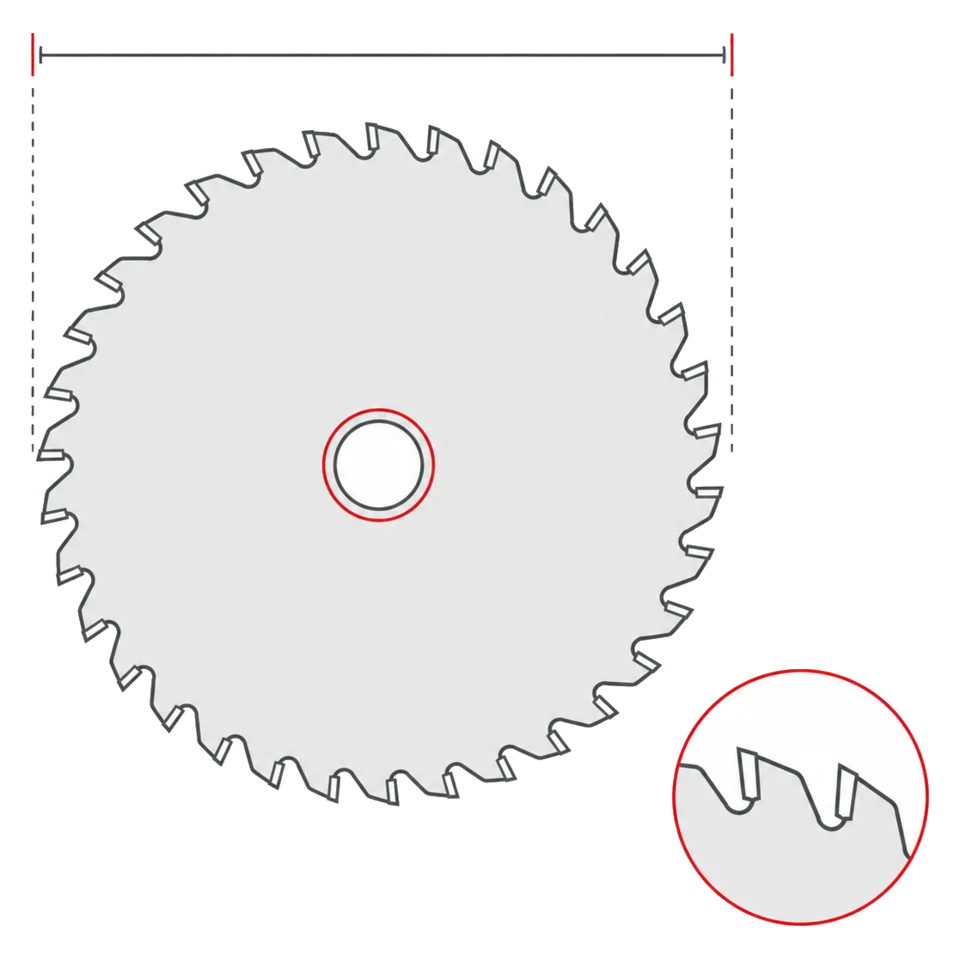
Work in the opposite direction. Diameter and bore are determined by the machine and are non-negotiable. Fixing them first eliminates most possibilities in a single step. In a professional circular saw blade range, where diameters extend from 80 to 760 mm and bores from 15.88 to 80 mm, this is the most effective filter.
Material and cutting direction come next and identify the blade family. Tooth count comes last, because it is the parameter that usually offers a genuine choice: the same diameter is often available with two or three tooth counts so that the result can be adjusted to the task.
The five specifications to check
These are the columns found in every technical table, listed in the order in which they should be read:
| Specification | Symbol | Determined by | What happens if it is wrong |
|---|---|---|---|
| Diameter | D | The machine | The blade does not fit inside the guard or cannot reach the required cutting depth |
| Bore | d | The machine spindle | The blade cannot be fitted or runs eccentrically |
| Pin-hole pattern | NL / KN | The machine flange | The blade slips on the spindle under load |
| Kerf and plate thickness | B and b | The task and available power | Excessive waste, or a blade that deflects and cuts out of line |
| Tooth count | Z | The required finish | A chipped edge, or burning and excessively slow feed |
D, B, b, d and Z are the same symbols used throughout the family pages in the catalogue. Once understood, they apply to the entire range.
The procedure, step by step
-
Read the diameter and bore from the machine
They are marked on the fitted blade or stated in the manual. Never exceed the permitted maximum diameter: it determines peripheral speed and therefore forms part of the machine's safety limits.
-
Check the additional pin holes
Many industrial machines drive the blade through pins in addition to the central bore. If the flange has pins, the blade must have matching holes. Patterns such as FT01 or FT02 combine several holes on one blade to accommodate different flanges.
-
Identify the material and cutting direction
Solid wood or panel, coated or uncoated, ripping or crosscutting. This pair of requirements leads directly to the family: blades for solid wood and blades for melamine-faced panels use different tooth geometries and are not interchangeable.
-
Choose the tooth count
More teeth generally produce a cleaner edge, but require a more controlled feed and effective dust extraction. Fewer teeth cut faster and usually generate less heat. The catalogue often offers both options for the same diameter.
-
Check the permitted speed
Compare the maximum speed marked on the blade with the machine speed. The correct maximum decreases as diameter increases, and for some applications—such as dry cutting steel—it can be an order of magnitude lower than for wood.
A family and a product code are not the same thing
A family defines a technical configuration: carbide grade, tooth geometry, hook angle and field of application. A product code identifies one dimensional configuration within that technical design.
The distinction is practical. When someone says that they use an LU2A, they are describing a cutting solution, not an orderable item. That designation alone covers 40 configurations, from a 150 mm blade for a portable saw to a 760 mm blade for a panel sizing saw. Only the complete product code and item number identify the individual blade.
On each catalogue page the family appears at the top with its geometry and field of application, while the table below contains the product codes. The diameter and bore selector exists precisely to move from the family level to the correct configuration.
Common mistakes
-
Choosing the highest tooth count ‘to be safe’
A very fine tooth pitch on a thick panel does not necessarily improve the finish. It reduces chip space, raises the temperature and may burn the edge. Tooth count must be selected in relation to material thickness, not simply according to the desired finish.
-
Ignoring the pin-hole pattern
A correct central bore is not enough if the machine uses drive pins. This check takes thirty seconds; overlooking it can make the blade unusable.
-
Using a solid-wood blade on a coated panel
A laminate requires tooth geometry that scores the coating before removing it. A ripping blade used on a melamine-faced panel produces exit-edge chipping that no machine adjustment can correct.
-
Comparing two blades by tooth count alone
Two blades with the same Z can behave in opposite ways when tooth geometry and hook angle differ. Tooth count is the last comparison parameter, not the first.
Frequently asked questions
01 Can I use a blade with a smaller diameter than the machine specification?
Yes, provided the cutting unit allows it mechanically, but cutting depth is reduced and the blade runs at a lower peripheral speed than intended. It is a workaround, not an optimum technical choice.
02 Can the bore be adapted with a reduction bush?
Precision reduction bushes exist and are included in manufacturers' ranges, but they should be used only when specified for that combination. An improvised adapter introduces eccentricity and vibration that immediately affects the cut edge.
03 How many teeth are needed for a clean cut?
It depends on material and thickness; no single number works in every case. A commonly used starting point is to keep about three or four teeth engaged simultaneously. Fewer teeth can make the cut aggressive, while too many retain chips and heat. Use the calculator as an indicative check, then follow the blade and machine manufacturer's data.
04 What is the difference between kerf and plate thickness?
B is the width of the slot left in the material, measured across the teeth; b is the thickness of the steel plate. B is always greater than b, and this clearance prevents the plate from rubbing against the sides of the cut.
05 Does a more expensive blade cut better?
It is usually designed to maintain its performance for longer, which is not exactly the same thing. Price differences often reflect carbide quality, plate manufacture and balancing. Two new blades may look similar on the first cut, but differ after extended use.
06 How do I know whether a blade is compatible with my squaring saw?
Check three items: diameter within the permitted maximum, bore identical to the spindle and a pin-hole pattern matching the flange. The machine speed must also remain below the maximum speed marked on the blade.
07 Can I use the same blade for ripping and crosscutting?
Yes. Some families are intended for both directions and the catalogue states their expected performance for each. If your work is almost entirely crosscutting, however, a dedicated blade generally gives a better edge at the same feed rate.
08 How much does the machine affect the final result?
A great deal. Bearing condition, flange flatness, fence alignment and workpiece clamping can affect the edge as much as the blade. If the cut suddenly deteriorates with the same blade, inspect the complete setup rather than assuming that blade choice is the only cause.
Technical review
Filippo Perissinotto
Technical reviewer for wood and wood-based materials
Graduate in Wood Technology and Industries, technical consultant and wood-sector specialist.
The review covers the accuracy, clarity and consistency of information relating to wood and wood-based materials. Tool setup, machine operation and safety must always be checked against the manufacturer’s documentation and instructions.
Profile, qualifications and review methodRelated guides