Blade selection
How to choose the tooth count for a circular saw blade
At a glance
Tooth count is selected in relation to material thickness. A useful starting point is to keep about three or four teeth engaged simultaneously: too few can make the cut aggressive and unstable, while too many reduce chip space and increase heat. The manufacturer's formula provides an indicative Z value, which must then be matched to an available blade configuration.
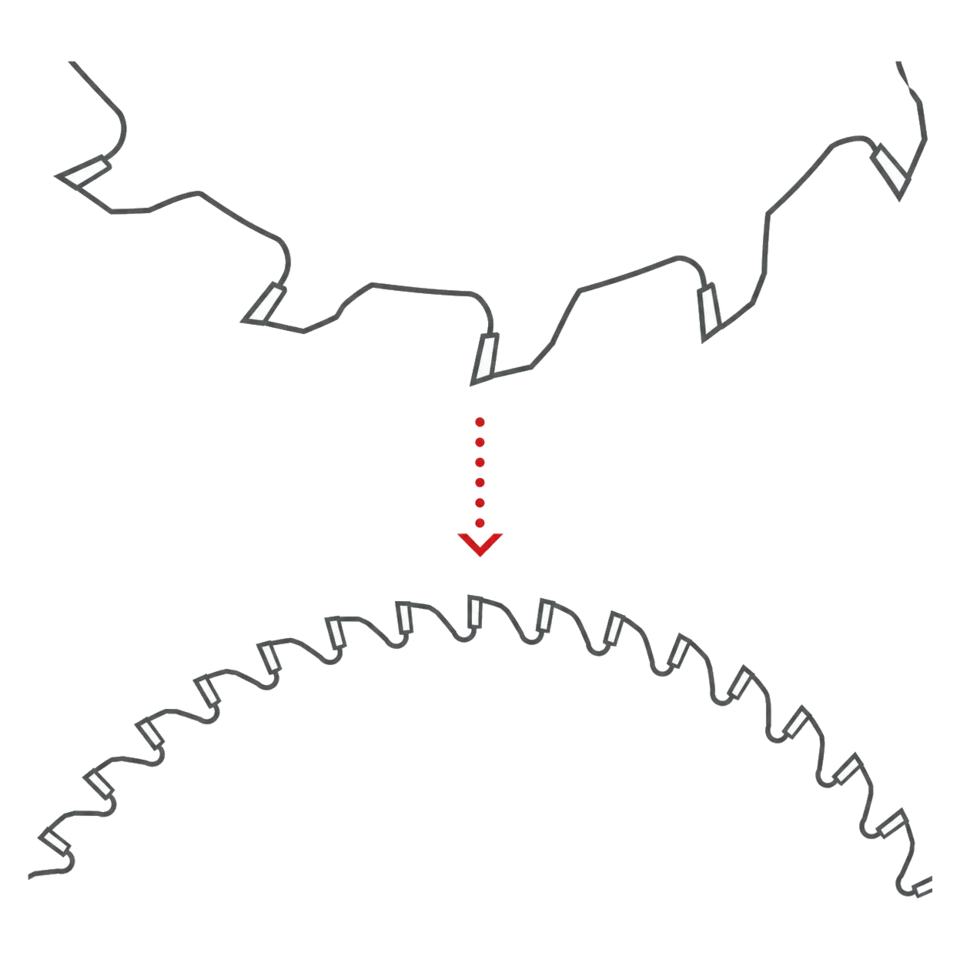
What tooth count actually controls
Z is not a quality rating. It is the number of cutting edges sharing the work during one revolution and therefore affects how much material each tooth removes. At the same feed rate, doubling the tooth count halves chip thickness: the edge can be cleaner because each tooth removes less fibre.
The trade-off is mechanical. More teeth mean smaller gullets, and the gullet is the only space that carries the chip until it leaves the cut. If it fills too early, chips are recut, the blade heats up and the workpiece becomes marked—often noticeable by smell before it is visible on the edge.
This is why tooth count must be related to thickness. In an 18 mm panel a tooth remains engaged over a short path and can have a small gullet. In 60 mm solid wood, each tooth follows a longer path and must remove far more material, so a coarse tooth pitch and large gullet are required.
A commonly used starting point is about three or four teeth engaged at once. Below that, engagement becomes more intermittent and the cut more aggressive. Far above it, chip evacuation and heat can become the limiting factors. For a given diameter, thicker material therefore generally requires fewer teeth and thinner material can use more.
Coarse or fine tooth pitch: what changes
Neither option is inherently better. They are different compromises, and a gain on one side has a cost on the other:
| Aspect | Coarse tooth pitch | Fine tooth pitch |
|---|---|---|
| Edge finish | More pronounced tooth marks; delicate materials may need finishing | A more closed edge directly from the machine |
| Feed | Accepts higher feed rates | Feed must be controlled so the gullets can evacuate chips |
| Heat | Generally lower because chips leave the cut and carry heat away | Can rise quickly in thick material |
| Power demand | Lower at the same cutting speed | Higher and more noticeable on small motors |
| Natural field of use | Thick solid wood, ripping and cordless cutting | Thin panels, coated materials and crosscutting |
This comparison assumes the same tooth geometry. If geometry or hook angle changes, two blades with the same Z can behave differently.
Tooth counts actually available
A family's total Z range means little without diameter. The centre column shows real choices at the widely used 300 mm diameter and reveals the practical distance between families.
| Family | Z across the family | At 300 mm | Application |
|---|---|---|---|
| LU1C | 22–48 | Z26 | Ripping and gang cutting solid wood |
| LU2A | 18–96 | Z36 or Z48 | Panels, ripping and crosscutting |
| LU2B | 36–132 | Z60 or Z72 | Panels, with a finer pitch than LU2A |
| LU2C | 48–168 | Z96 or Z120 | Crosscutting panels and wood composites only |
| LG2B | 60–84 | Z60 or Z72 | Panel finishing on squaring and table saws |
At the same diameter, LU2C Z120 has almost five times as many teeth as LU1C Z26. The family defines the technical design; the product code defines the orderable configuration.
Formulas for estimating tooth count
These manufacturer formulas start from material thickness. S is cutting thickness, D is blade diameter and P is the pitch between adjacent teeth.
| Step | Formula | How to use it |
|---|---|---|
| A. Pitch | P = S × 1.4142 / 3 | Gives the pitch for approximately three engaged teeth. Divide by four instead of three for approximately four engaged teeth |
| B. Tooth count | Z = D × 3.14 / P | Converts pitch into a tooth count for the blade diameter used on the machine |
| C. Shortcut | Z = D × 8 / S | Provides Z directly. It does not apply to blades for ferrous metals |
These formulas apply to crosscutting and wood composites such as MDF, plywood, chipboard and laminated panels. They do not apply to ripping, where chip evacuation rather than engaged-tooth count is the primary criterion.
A worked example
Consider an 18 mm melamine-faced panel, a 300 mm blade and a crosscut. Formula A gives a pitch just over 8.4 mm for three engaged teeth; formula B then gives about 111 teeth. The more conservative shortcut gives 133.
At 300 mm the LU2C is available as Z96 and Z120. The theoretical value falls between them and Z120 is the nearest real configuration. This is the purpose of the calculation: the theoretical number rarely coincides exactly with an available code.
Repeat the calculation for a 30 mm panel and the complete formula falls to about 67 teeth, while the shortcut gives 80. Z96 becomes the closer option. Two tooth counts at one diameter therefore cover different thickness ranges; they are not simply two quality levels.
Why the same range reaches 168 teeth
LU2C reaches 168 teeth at 600 mm. It is intended only for crosscutting and uses a positive 5° hook angle, so finish depends heavily on the number of cutting edges passing across the exit edge.
LU1C stops at 48 teeth on the 550 mm version. It is intended for ripping and gang cutting, where chips are long and abundant: adding teeth would mainly fill the gullets. It offers one tooth count per diameter, from Z22 at 250 mm to Z48 at 550 mm.
LU2A sits between them, spanning Z18 to Z96 and working in both directions. At 250 mm it offers Z30 and Z40; at 400 mm, Z48 and Z60. The two choices at each diameter allow the application to be adjusted without changing family.
How to reach the right number
-
Measure the actual cutting thickness
Use the thickness the blade actually passes through, including the full stack when cutting several panels. This determines how many teeth remain engaged.
-
Use the formulas for crosscutting or composites
Calculate pitch from thickness and Z from pitch and diameter, or use Z = D × 8 / S as a cautious shortcut. For ripping, use chip-evacuation criteria instead.
-
Check how many teeth are engaged
About three or four is a useful initial target. Too few can make engagement aggressive; too many leave insufficient room for chips.
-
Compare with the real feed rate
A fine pitch only works if feed can be controlled. On a fixed-feed line, raising Z without changing operating conditions can simply add heat.
-
Check dust extraction
Fine chips from a high tooth count remain in the cut if extraction is weak or poorly positioned. A medium tooth count can be more robust on machines with modest extraction.
-
Choose a product code, not only a number
After identifying Z, verify that it exists with the required diameter and bore. Some combinations are not offered and may require a different family.
Common mistakes
-
Increasing tooth count to cure chipping
On coated panels, chipping is often caused by tooth geometry, machine setup or the absence of a scoring blade, not simply by Z. More teeth alone cannot correct the wrong cutting system.
-
Using a panel tooth count on thick solid wood
A Z96 blade in 50 mm solid wood will not necessarily finish better; its gullets can fill early and the blade may rub and burn instead of cutting efficiently.
-
Comparing Z across different diameters
Z48 on a 250 mm blade and Z48 on a 550 mm blade represent very different pitches. Compare tooth counts only at the same diameter, or compare pitch instead.
-
Assuming every stated tooth has the same role
On multiripping blades the notation may distinguish cutting teeth from stabilising teeth, while on two-part scoring blades Z can be the sum for both sections. Read the manufacturer's notation before comparing values.
Frequently asked questions
01 Is there a formula for calculating tooth count?
Yes. Estimate pitch with P = S × 1.4142 / 3, then calculate Z with Z = D × 3.14 / P. The shortcut Z = D × 8 / S is also used. These apply to crosscutting and wood composites, not ripping, and the shortcut excludes blades for ferrous metals.
02 Can I feed faster with more teeth?
Usually the opposite. More teeth reduce gullet volume and often require a more controlled feed. If Z increases without adapting feed, extraction and thickness, chips and heat can accumulate.
03 Why does one family have such different tooth counts?
Because it covers widely different diameters and must maintain a suitable pitch. LU2A ranges from Z24 at 150 mm to Z96 at 600 mm: four times as many teeth for roughly four times the circumference.
04 Is a high tooth count preferable on raw chipboard?
Not necessarily. Raw chipboard is abrasive and its edge is often not exposed. A medium tooth count can cut faster and avoid unnecessary heat while maintaining adequate quality.
05 How can I tell if the pitch is too fine?
Look at chips and the cut edge. Very fine dust instead of chips, a hot edge, dark marks and a sharper continuous sound can indicate poor chip evacuation and excessive rubbing.
06 Does tooth count affect blade life?
Yes in both directions. More cutting edges can share the load, but if the pitch is too fine for the thickness, additional heat accelerates carbide wear and removes that advantage.
07 Can I use fewer teeth for rough cutting?
Yes. Where the workpiece will be finished later, a coarse pitch can reduce power demand and permit a higher feed, leaving a fine-tooth blade for final sizing cuts.
08 Do two blades with the same Z cut in the same way?
No. Tooth geometry, hook angle, carbide grade, diameter and plate design matter as much as tooth count. LU2C and LU2B can have similar Z values but different hook angles and different exit-edge behaviour.
Technical review
Filippo Perissinotto
Technical reviewer for wood and wood-based materials
Graduate in Wood Technology and Industries, technical consultant and wood-sector specialist.
The review covers the accuracy, clarity and consistency of information relating to wood and wood-based materials. Tool setup, machine operation and safety must always be checked against the manufacturer’s documentation and instructions.
Profile, qualifications and review methodRelated guides