Cutting applications
Ripping vs crosscutting: differences and blade choice
At a glance
When ripping, teeth separate fibres along their length and must clear long chips, so low tooth counts and large gullets are preferred. When crosscutting, teeth must sever fibres cleanly, so finer tooth counts and bevelled cutting edges give a better exit edge. A combination blade covers both, while a dedicated blade performs better when one operation dominates.
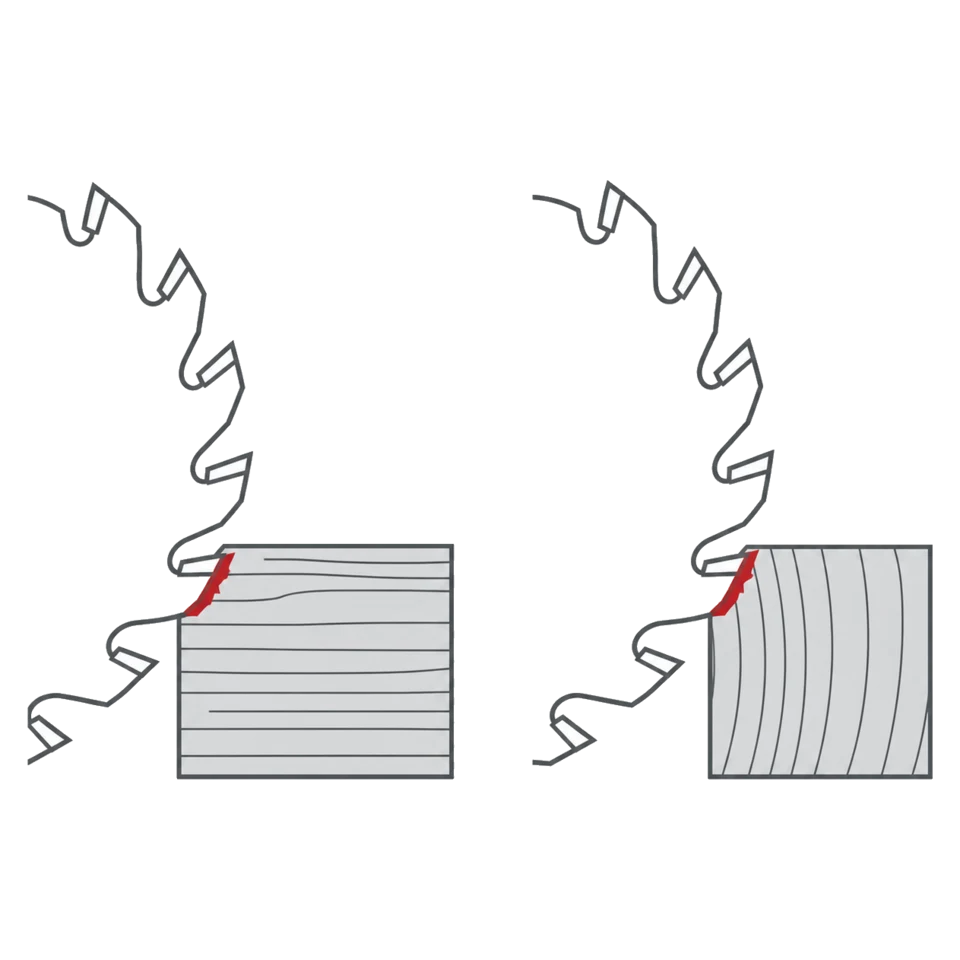
Two different operations on the same board
Ripping runs parallel to the fibres. It produces long, bulky chips that need large gullets and creates continuous side friction.
Crosscutting severs fibres across their ends. The unsupported exit fibres can lift and splinter unless a sharp bevelled tooth cuts them before pushing them away.
This physical difference explains why ripping blades are coarse and crosscut blades are fine. Tooth-engagement formulas used for panels and crosscuts are not normally applied to ripping, where chip clearance is the main constraint.
Practical differences
| Feature | Ripping | Crosscutting |
|---|---|---|
| Chip | Long and bulky; large gullet required | Short and fine |
| Typical tooth count | Low | High |
| Hook angle | Positive and relatively aggressive | More moderate |
| Feed | Can remain high | Usually lower for a clean edge |
| Typical defect | Burning or the cut closing on the plate | Exit-edge splintering |
In wood-based panels, behaviour also depends on layer structure and surface coating.
How these differences appear in the catalogue
Dedicated ripping families use low tooth counts and normally offer one coarse configuration for each diameter. LU1C ranges from Z22 at 250 mm to Z48 at 550 mm, including Z26 at 300 mm and Z34 at 400 mm. These blades are designed to remove material and clear chips rather than produce a finished crosscut edge.
LU1E follows the same ripping logic with a flat-top tooth, a 15-degree positive hook and a kerf between 2.5 and 3 mm. Removing less material reduces power demand and allows a high feed rate on machines that are not industrial production lines.
At the opposite end, LU2C is dedicated to crosscutting and uses a hook angle of only 5 degrees. At 250 mm it is offered in Z80 and Z100; at 300 mm in Z96 and Z120; the range reaches Z168 at 600 mm. The two tooth counts for a diameter cover different workpiece-thickness bands, not simply two grades of finish.
For picture frames and accurate joints, LU1I uses 20-degree ATB teeth with a 10-degree hook on diameters from 200 to 350 mm. At 250 mm, Z80 and Z96 versions are available for close-fitting joints, including painted or coated profiles.
Battery-powered gang ripping is the extreme case. LM05 uses flat-top cutting teeth, a 12-degree positive hook and stabilising teeth, and is intended in particular for timber above 10% moisture. The 300 mm version has 20 cutting teeth and the 600 mm version only 32, leaving the gullet volume needed for wet chips.
Examples from the catalogue
| Family | Ripping | Crosscutting | Example at 300 mm |
|---|---|---|---|
| LU1C | Excellent | Not intended | Z26 |
| LU1E | Excellent | Not intended | Z24 or Z28 |
| LU2A | Very good | Excellent | Z36 or Z48 |
| LU2C | Not intended | Excellent | Z96 or Z120 |
| LU1I | Not intended | Excellent | Z96 or Z112 |
Not intended means that the geometry was not designed to optimise that operation.
Combination or dedicated blade?
-
Estimate the workload split
If neither direction accounts for roughly 70–80% of the work, a combination blade often saves more machine time than two dedicated blades.
-
Check the finish requirement
A dedicated crosscut blade pays off when the edge remains visible or must form a close joint.
-
Consider the available feed rate
Fine crosscut blades need a controlled feed. A fixed high-throughput line may favour a more versatile geometry.
-
Include changeover time
On a panel saw, changing the main blade can also require scorer realignment.
-
Test on scrap
Make two cuts at the same feed and compare the exit edge under raking light.
Common mistakes
-
Crosscutting with the fitted ripping blade
The time saved at the machine is often lost repairing a splintered edge.
-
Increasing rpm to improve the edge
Speed is constrained by blade diameter and machine limits; excess speed adds heat rather than cleanly severing fibres.
-
Using a crosscut blade to rough-rip thick timber
Small gullets fill with long chips, load the motor and heat the cut.
-
Assuming panels have no direction
Plywood layers and surface coatings can still create a preferred cutting direction and a vulnerable exit face.
Frequently asked questions
01 How can I identify the cutting direction?
Follow the visible grain. A cut parallel to it is a rip cut; a cut across it is a crosscut. Deviated grain can alternate the condition within one cut.
02 Is a combination blade always a compromise?
No. A well-designed ATB combination blade can perform strongly in both directions; a dedicated blade mainly gains finish or chip-clearance capacity at the extreme.
03 Why does the lower edge splinter?
On the exit side there is no material supporting the fibres as the tooth leaves the cut.
04 Does the same rule apply to gang cutting?
Even more strongly: the stack multiplies chip volume, so low tooth counts and adequate gullet capacity become critical.
05 What changes with wet wood?
Moist chips are more cohesive and fill the gullet sooner. Use a blade intended for the moisture level and reassess feed rate.
06 Does crosscutting always require a scoring blade?
No. A scorer is mainly needed for coated panels. Solid wood and uncoated panels can be cut cleanly with the correct sharp ATB blade.
07 Can a backing board reduce splintering?
Yes. It is the most economical option when no scoring unit is available. A sacrificial panel held firmly against the exit face supports the fibres and limits breakout, provided the workpiece remains securely clamped.
08 Does tooth count alone identify whether a blade is for ripping or crosscutting?
It is an indication, not proof. Very high tooth counts usually point to crosscutting and low counts to ripping, but hook angle and tooth geometry provide the decisive evidence because they determine how the blade actually cuts.
Technical review
Filippo Perissinotto
Technical reviewer for wood and wood-based materials
Graduate in Wood Technology and Industries, technical consultant and wood-sector specialist.
The review covers the accuracy, clarity and consistency of information relating to wood and wood-based materials. Tool setup, machine operation and safety must always be checked against the manufacturer’s documentation and instructions.
Profile, qualifications and review methodRelated guides