Materials
MDF: structure, cutting behaviour and blade selection
At a glance
MDF is wood fibre reconstituted with thermosetting resin under pressure and heat. It has no grain, so cutting direction does not change its basic behaviour. Resin distributed throughout the board is abrasive and wears the edge continuously. A suitable blade uses an appropriately fine tooth count, moderate positive hook and carbide selected for wear resistance.
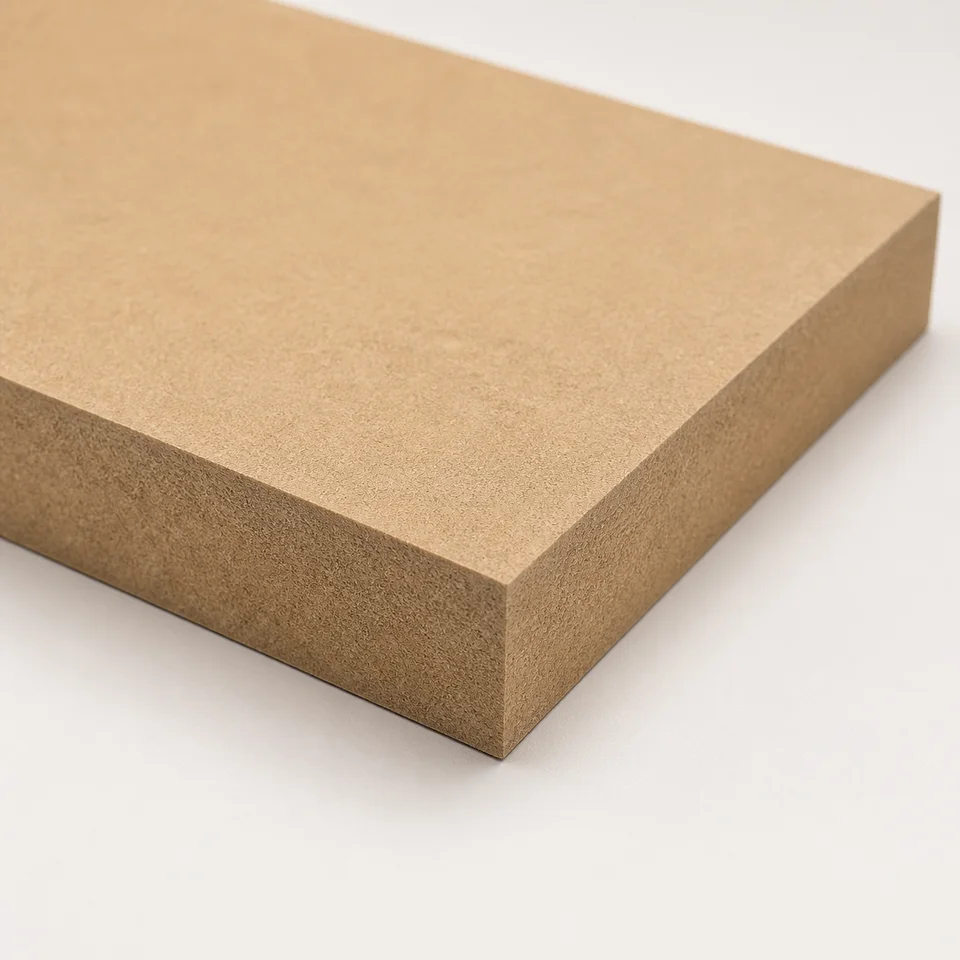
What is inside an MDF panel
MDF means Medium Density Fibreboard. The name identifies the two useful facts: it consists of fibres, rather than particles or veneers, and density strongly influences behaviour.
Small wood and sawmill residues are chipped and steam-refined into individual wood fibres. Thermosetting resin, usually urea-based, plus wax and additives are added; the fibres are dried, formed into a continuous mat and hot-pressed until the resin cures.
The result has no grain direction. Unlike solid wood or plywood, fibres are randomly distributed through every plane, so the panel behaves similarly in every cutting direction.
Its faces are denser than the core because pressing compacts the outer zones. This gives MDF its smooth paintable surface, but makes the tooth cross a density gradient: hard face, softer core and hard exit face.
MDF variants encountered in the workshop
The MDF label covers panels with different densities, binders and additives.
| Type | How it is commonly identified | Difference | Cutting effect |
|---|---|---|---|
| Standard MDF | Natural beige to light brown | Reference density and conventional binder | Uniform behaviour and progressive edge wear |
| Moisture-resistant MDF | Often green through the core | More moisture-resistant resin system | Tougher under the tooth and can generate more heat |
| Fire-retardant MDF | Often coloured red | Flame-retardant additives throughout | Mineral additives substantially increase abrasion |
| HDF | Thin sections with a very hard closed surface | Higher density than standard MDF | Often needs a finer pitch and lower feed |
| Lightweight MDF | Noticeably lower weight at equal size | Reduced density | A more fragile edge prone to exit fraying |
| Faced or laminated MDF | Factory-applied melamine or laminate surface | The substrate is MDF but the surface is another material | The coating, not the core, determines blade choice |
Core colour is common identification practice but not a universal standard. Confirm the manufacturer's product specification.
Why it wears the edge more than expected
A new blade meets little cutting resistance in MDF. The machine does not appear heavily loaded, but low resistance should not be confused with low wear.
The main abrasive is the resin distributed uniformly through the board. It does not usually chip the carbide; it removes sharpness gradually and consistently. The blade continues to cut while quality declines one component at a time.
Indirect symptoms appear first: feed force rises, the blade runs hotter, slight exit-side darkening appears and dust becomes finer. By then the edge may have been dull for some time.
Fire-retardant MDF accelerates the process because mineral additives are more abrasive than resin alone. Where standard and fire-retardant grades share one blade, plan service around the more severe material.
How panel thickness changes theoretical tooth count
Raw and coated MDF are different cutting tasks
Raw MDF
The tooth works on fibre
- Progressive wear is usually more critical than edge tear-out
- ATB with a moderate positive hook is normally sufficient
- Medium-high tooth counts are enough; maximum Z is not automatically better
- No scoring blade is required
- Selection balances finish against the interval between sharpenings
Faced or laminated MDF
The tooth works on the coating
- Exit-side coating chipping becomes the main risk
- TCG scores the surface before clearing the substrate
- High tooth counts and a modest or negative hook are common
- A squaring saw normally uses a scorer; no-scoring work needs a declared family
- Edge quality becomes the first constraint
MDF dust is not ordinary sawdust
MDF produces very fine dust because it is made from already separated short fibres. It remains airborne and may not be fully captured by extraction designed for coarse solid-wood chips.
Use effective extraction and suitable respiratory protection in accordance with workplace requirements and the product safety data. Uncaptured dust also returns to the kerf, increases plate friction and contributes to heat.
The ideal MDF blade and setup
Six checks that together define a suitable tool.
-
A fine tooth count matched to thickness
MDF has no grain direction; Z controls edge closure and shares wear. At 300 mm, Z60 to Z96 covers much routine work, with higher counts reserved for thin visible edges where the catalogue provides them.
-
ATB on raw MDF, TCG on coated MDF
ATB cleanly severs exposed fibre. On a brittle coated surface, a trapezoidal tooth first scores the layer and a flat tooth clears the bottom.
-
A moderate positive hook angle
Too positive can lift exit fibres; too small can rub and heat. General panel families often use +10° to +15°, decreasing for finish-oriented and coated-panel designs.
-
Carbide selected for wear resistance
General panel families use grades such as H01K, finer-pitch ranges H00K and faced-panel or industrial sizing families H00XA. These are application compromises, not a simple quality ranking.
-
A plate with anti-vibration features where specified
Changes between dense faces and a softer core can excite the blade. Laser-cut damping features reduce oscillation, noise and cut waviness.
-
Kerf suited to the machine
Thin kerf removes less material, produces less dust and suits portable or cordless saws. Stationary high-feed machines benefit from a more robust plate that remains stable under load.
Where these characteristics appear in the catalogue
All these families declare MDF; each prioritises a different aspect.
| Family | Geometry and carbide | Teeth at 300 mm | Appropriate use |
|---|---|---|---|
| LU2A | ATB, H01K | 36 and 48 | Mixed raw-panel work where one blade must cover many tasks |
| LU2B | ATB, H00K | 60 and 72 | A more closed edge than LU2A at a lower feed |
| LG2C | ATB, H00K | 96 | Thin sections and visible edges requiring fine pitch |
| LU1I | ATB 20°, H00K | 96 and 112 | Mouldings and final visible edges |
| LU3D | TCG, H00XA | 72–96 | Faced or laminated MDF with a scoring unit |
| LG3D | TCG, H00XA | 72 and 96 | Faced MDF in a compact squaring-saw range |
| FRWBC | ATB, HW K05S | 48, 72 and 100 | MDF on a compact table saw |
Carbide codes describe different hardness-and-toughness balances, not a simple quality scale.
Common mistakes
-
Selecting as if MDF were softwood
MDF feels easy to cut, but resin works against the edge continuously. In production, the correct carbide grade can materially extend time between sharpenings.
-
Exceeding the calculated Z on thick panels
On 30 or 38 mm MDF, very fine pitch reduces gullet volume, retains dust, adds heat and can darken the edge. Thickness may call for fewer rather than more teeth.
-
Using the raw-MDF blade on faced MDF
The same substrate presents a different operation once coated. General ATB can lift the exit coating; use scoring geometry and a scorer where specified.
-
Failing to remove resin deposits
Deposits behind the edge and on the plate add friction even while the carbide remains sharp. Clean in accordance with blade and coating instructions and avoid unsuitable caustic products.
-
Using extraction designed only for solid-wood chips
Fine MDF dust can load inappropriate filters and return to the cut, raising friction as well as exposure. Extraction must be suitable for the dust produced.
Frequently asked questions
01 Does MDF have a grain direction?
No. Fibres are randomly distributed, so basic cutting behaviour is similar in every direction. Tooth count depends mainly on thickness and the required edge.
02 Why does an MDF edge become fuzzy?
The tooth has lifted fibres rather than severed them. Common causes are a dull edge, unsuitable hook angle or a tooth count too low for the thickness; inspect edge condition first.
03 Which carbide grade is suitable for MDF?
Use the grade specified by the declared family and application. General ranges use H01K, finer-pitch ranges H00K and coated-panel or industrial ranges may use H00XA, prioritising wear resistance.
04 Are moisture-resistant and fire-retardant MDF cut like standard MDF?
They use similar geometry but have different wear expectations. Moisture-resistant resin can generate more heat; fire-retardant mineral additives are markedly more abrasive.
05 Is a scoring blade required for MDF?
Not for raw MDF. It becomes relevant on faced or laminated MDF, where it severs the lower coating ahead of the main blade.
06 How many teeth for 18 mm MDF?
The cited 300 mm formula produces a theoretical value around 110 for roughly three engaged teeth. Compare the nearest real configurations: Z96 can suit a visible edge, while Z72 may suit an edge that will be covered.
07 Why does a blade heat up in thin MDF?
Fine dust can fill small gullets and remain in the cut. Depending on the configuration, fewer teeth or a suitable higher feed may reduce rubbing; do not automatically slow down.
08 Can one blade cut both MDF and chipboard?
Yes, many general panel families declare both. MDF can often use a finer pitch; raw chipboard may benefit from a medium count and larger evacuation space.
Technical review
Filippo Perissinotto
Technical reviewer for wood and wood-based materials
Graduate in Wood Technology and Industries, technical consultant and wood-sector specialist.
The review covers the accuracy, clarity and consistency of information relating to wood and wood-based materials. Tool setup, machine operation and safety must always be checked against the manufacturer’s documentation and instructions.
Profile, qualifications and review methodRelated guides