Machines
How to choose a blade for a sliding table saw
At a glance
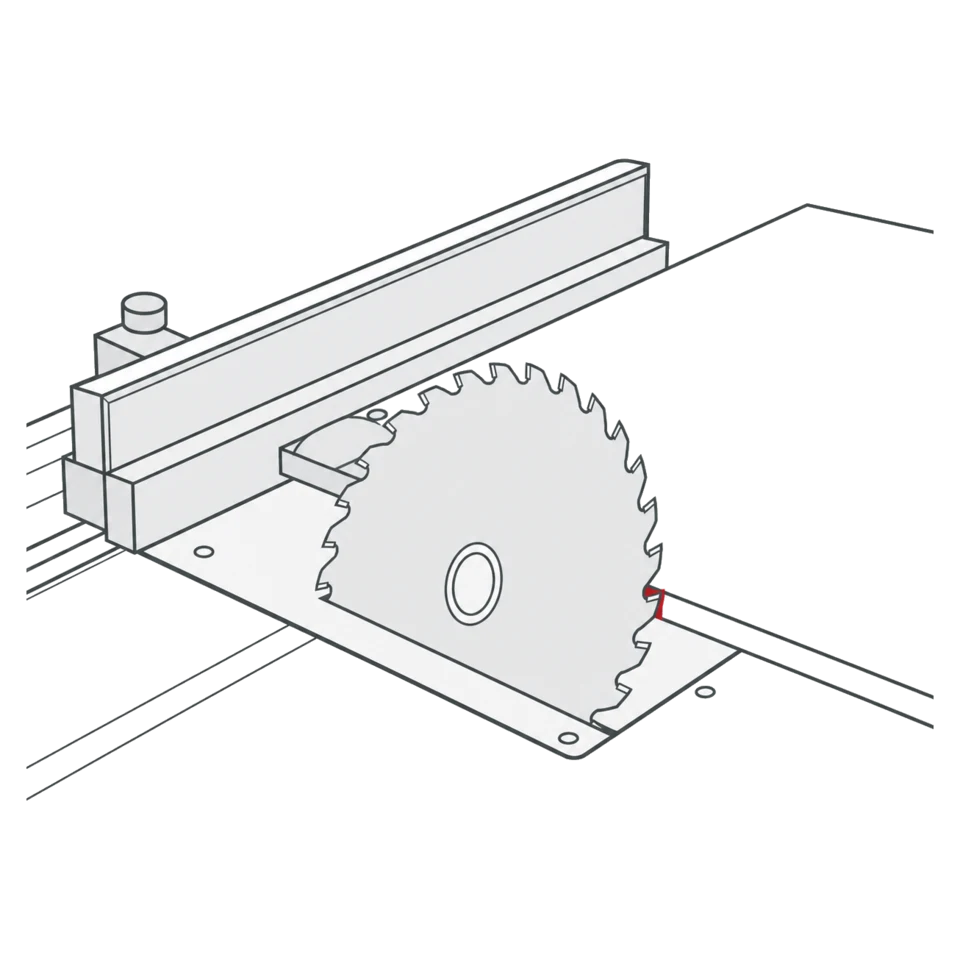
On a sliding table saw, the machine determines maximum diameter, bore, drive pattern and speed. Then select the family for the material and the tooth count for the workpiece thickness. If a scorer is fitted, choose and set the main blade and scorer as a matched cutting system.
Checks to make before ordering
Each item can independently rule out a blade. Check them with the machine isolated from its power supply.
-
Maximum blade diameter
Check the guard, lift travel, riving knife and scorer clearance—not just the visible free space.
-
Arbor bore
Measure the clean arbor directly with calipers. The bore must match exactly, without perceptible play.
-
NL or KN drive system
Protruding pins require matching NL holes; record hole quantity, diameter and pitch circle. A rectangular keyway is specified as KN width by depth.
-
FT drilling pattern
Confirm the exact FT pattern. FT01 includes 2/7/42, 2/9/46.4 and 2/10/60; FT02 and FT03 cover only defined subsets.
-
Flange diameter and parallelism
Use equal, clean flanges, as large as practical and never smaller than one third of blade diameter: at least 100 mm for a 300 mm blade.
-
Arbor condition
The arbor must be straight and within h7 tolerance. A damaged arbor produces periodic edge waviness even with a new blade.
-
Scoring unit
Record scorer diameter, bore and whether it is a two-piece adjustable or one-piece conical design.
-
Machine speed
Stay below the blade limit: the general reference is 8,000 rpm at 250 mm, 6,500 at 300 mm and 5,500 at 350 mm. Check the machine's highest available speed.
Diameter, bore and drive pattern are fixed constraints. Material selection starts only after all three match.
Find families with your diameter and bore
Enter the two machine dimensions to eliminate incompatible codes.
The tool checks diameter and bore. Verify drive holes separately.
Families intended for sliding table saws
| Family | Diameters (mm) | Bores (mm) | Application |
|---|---|---|---|
| LU1C | 250–550 | 30–70 | Solid-wood ripping, Z22 to Z48 |
| LU2A | 150–760 | 20–80 | Panels, ripping and crosscutting |
| LU2B | 150–600 | 30–35 | Panels with finer tooth counts |
| LU3D | 200–350 | 30–60 | Two-sided laminates with scorer, TCG |
| LI16M | 80–200 | 20–50 | Two-piece adjustable scorers |
| LI25M | 80–340 | 16–80 | One-piece conical scorers |
A family range shows where to search; it does not mean every diameter/bore combination exists.
Why the scorer determines the main blade
The scorer runs in the opposite direction and pre-cuts the lower coating before the main blade arrives. The main blade can then concentrate on cleanly removing the core.
A family such as LU3D is designed to work with a scorer. Without one, a coated panel can still chip underneath. More teeth on the main blade do not replace scoring.
Main-blade kerf and scoring width must match. A narrow score still chips; an over-wide score leaves a visible step. Always set them on scrap.
Adjustable or conical scoring blade
Two-piece adjustable
LI16M, 80–200 mm
- Two adjacent discs; shims set the cutting width
- Some codes allow adjustment on the machine
- ATB 5° with 11° positive hook
- Listed Z is the total for both discs
- Width changes in defined shim increments
One-piece conical
LI25M, 80–340 mm
- One conical disc; height controls cutting width
- Each millimetre of height changes width by about 0.25 mm
- Conical ATB 6° with 15° positive hook
- Continuous adjustment in small verified steps
- Many codes match a specific machine manufacturer
Common mistakes
-
Ordering the main blade without checking the scorer
A blade intended for scored cutting may not produce a clean lower face when used alone.
-
Assuming the flanges are sound
Small, dirty or non-parallel flanges are a frequent cause of wavy cuts with a new blade.
-
Changing the main blade without resetting the scorer
A kerf change from 3.2 to 3.5 mm requires a new scorer setting.
-
Checking only the usual machine speed
On multi-speed machines, compare the blade with the highest selectable rpm.
-
Choosing the family before diameter and bore
The right material family may not exist in the machine's dimensional combination.
Frequently asked questions
01 What blade diameter does a sliding table saw use?
It depends on the cutting unit. Always follow the machine manufacturer's permitted range rather than a generic nominal size.
02 Can I fit a smaller blade?
Often yes if mechanically permitted, but available cutting depth and peripheral speed decrease.
03 How do I identify pin drive?
Remove the blade and inspect the flange. Protruding pins require matching NL holes; a plain flange normally relies on correct clamping friction.
04 Must I replace the scorer whenever I replace the main blade?
Not necessarily, but scoring width and alignment must always be checked and adjusted on scrap.
05 Combination blade or two dedicated blades?
If one operation does not dominate, a versatile blade often saves more time because each change can require scorer realignment.
06 Which tooth count should I use on a 300 mm blade for panels?
It depends on panel thickness and whether the edge remains visible. At 300 mm, LU2A is available in Z36 and Z48, while LU2B is available in Z60 and Z72. For an 18 mm panel with an exposed edge, use the upper part of the suitable range; for thicker panels or an edge that will be covered, the lower part normally offers longer service life.
07 Can the same blade cut both solid wood and panels?
Technically yes, with a combination family, but the compromise is visible. Dedicated solid-wood ripping blades use very low tooth counts, roughly Z22 to Z48 across the range, and those configurations leave a coated-panel edge that normally needs further finishing.
08 Why is the cut out of square?
First check blade-to-slot parallelism, fence alignment, flanges and workpiece support before blaming the blade.
Technical review
Filippo Perissinotto
Technical reviewer for wood and wood-based materials
Graduate in Wood Technology and Industries, technical consultant and wood-sector specialist.
The review covers the accuracy, clarity and consistency of information relating to wood and wood-based materials. Tool setup, machine operation and safety must always be checked against the manufacturer’s documentation and instructions.
Profile, qualifications and review methodRelated guides