Use and maintenance
Maximum rpm for a circular saw blade
At a glance
Permitted rpm falls as blade diameter rises: the general reference runs from 23,000 rpm at 100 mm to 6,500 at 300 mm and 2,250 at 800 mm. Never exceed the marked limit. If a family-specific table gives a lower value, that lower value always applies.
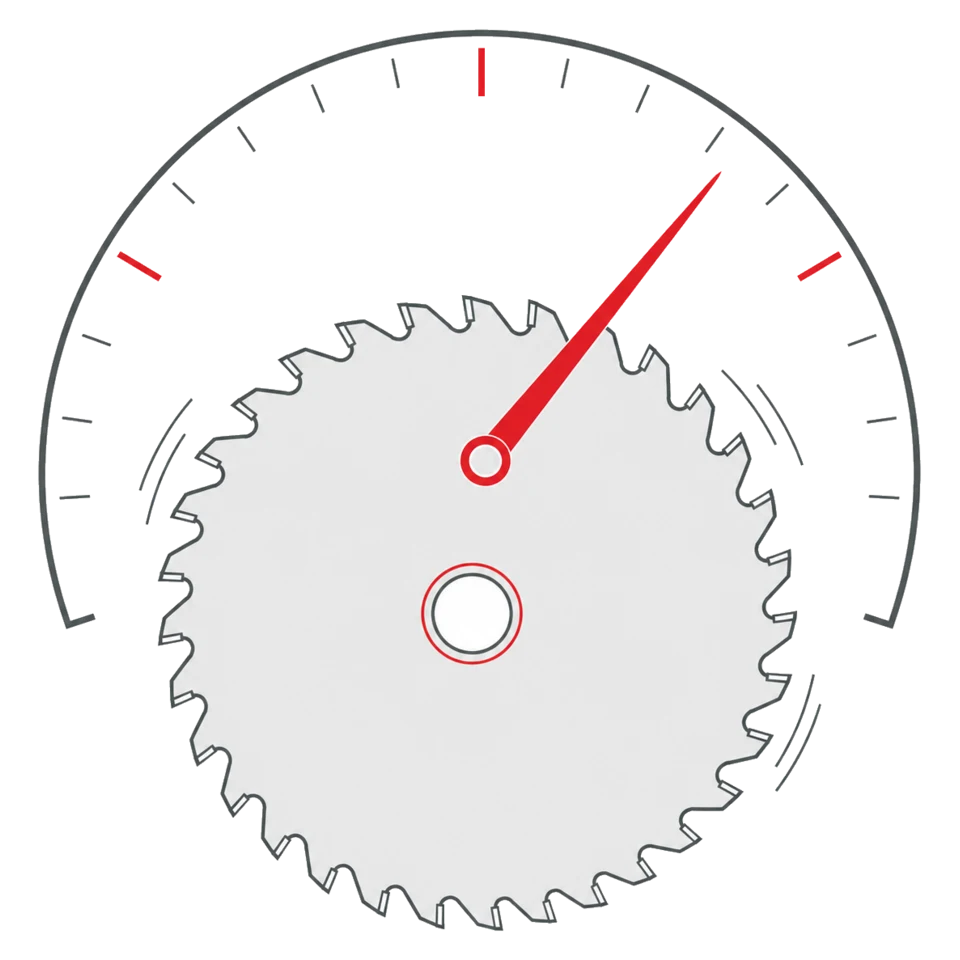
Maximum-rpm curves
The limit is non-negotiable
Never exceed the maximum rpm marked for the blade. Excess speed compromises blade behaviour, cut quality, service life and operator safety.
Fit, lock and align the blade only with the machine stopped, isolated and unable to restart.
Why larger blades run more slowly
The relevant quantity is tooth speed, not rpm alone. At the same rpm, a tooth on a 600 mm blade travels twice as far per revolution as one on a 300 mm blade.
Peripheral speed is V = π × D × n / 60,000, where D is diameter in millimetres, n is rpm and V is metres per second.
Although rpm changes roughly tenfold from 100 to 800 mm, the general table keeps peripheral speed in a much narrower range, about 120 to 94 m/s.
General rpm and peripheral speed
| Diameter (mm) | Maximum rpm | Peripheral speed (m/s) |
|---|---|---|
| 100 | 23,000 | about 120 |
| 150 | 14,500 | about 114 |
| 250 | 8,000 | about 105 |
| 300 | 6,500 | about 102 |
| 350 | 5,500 | about 101 |
| 500 | 3,750 | about 98 |
| 600 | 3,100 | about 97 |
| 800 | 2,250 | about 94 |
The slightly lower peripheral speed on large diameters adds margin as rotating mass and stored energy increase.
Check the reference rpm for your diameter
Enter blade diameter to compare the general rpm reference with the machine rating.
A lower family-specific or blade-marked limit always overrides this general reference.
When the blade family sets a lower limit
At 300 mm the general reference is 6,500 rpm, while an LU6A dry-cut steel blade is limited to 1,800 rpm. That corresponds to about 28 m/s instead of about 102 m/s.
Steel cutting without coolant requires much lower contact speed to control cutting-edge temperature. Whenever two limits exist, use the lower one.
The general table is a ceiling for the wider range; it never overrides a specific blade data sheet or the value marked on the plate.
Rpm alone does not determine cut quality
Finish depends on rpm together with feed rate—how much material each tooth removes.
On heat-sensitive plastics, feeding too slowly can make the tooth rub and re-melt chips onto the edge. On wood, slow feed can also cause heat and burning.
If quality suddenly deteriorates without a speed change, inspect edge sharpness, bearings, flange flatness, fence alignment and workpiece clamping first.
Common mistakes
-
Fitting a smaller blade simply to run faster
You lose cutting depth and may move away from the intended peripheral-speed range.
-
Applying the general table to a family with its own limit
A dry-cut steel blade may require less than one third of the general rpm for the same diameter.
-
Checking only the speed normally used
On a multi-speed machine, the blade must also be safe at the highest selectable setting.
-
Slowing feed to improve every finish problem
On plastics and PVC, excessive rubbing can melt chips back onto the cut edge.
-
Reusing one rpm value after changing diameter
Maximum speed is specific to blade diameter and must be checked at every blade change.
Frequently asked questions
01 What happens if I exceed maximum rpm?
Blade behaviour, finish and service life deteriorate, and the blade becomes unsafe. Never treat the marked maximum as an adjustable target.
02 How is peripheral speed calculated?
Use V = π × D × n / 60,000 with diameter in millimetres and speed in rpm; the result is metres per second.
03 Why can a small blade rotate faster?
Its tooth travels a shorter circumference each revolution, so higher rpm can produce a similar peripheral speed.
04 Is it a problem if my machine runs below the blade maximum?
It is not an overspeed safety issue, but tooth load and finish may change. Adjust feed or tooth count where appropriate.
05 Why do steel blades run so slowly?
Dry-cut steel requires lower contact speed to keep heat at the cutting edge under control.
06 Where do I find my blade's maximum rpm?
It should be marked on the blade plate together with diameter, bore and kerf. Follow that value and any lower machine limit.
07 Does rpm affect blade service life?
Yes, although usually through heat rather than direct mechanical wear. Excessive speed for the material can raise the cutting edge to temperatures that degrade the carbide; a permitted rpm combined with an unsuitable feed rate can produce the same effect.
08 Should rpm change when the material changes?
Often feed rate is the practical variable. Rpm remains constrained by the machine, diameter and blade-specific limit.
Technical review
Filippo Perissinotto
Technical reviewer for wood and wood-based materials
Graduate in Wood Technology and Industries, technical consultant and wood-sector specialist.
The review covers the accuracy, clarity and consistency of information relating to wood and wood-based materials. Tool setup, machine operation and safety must always be checked against the manufacturer’s documentation and instructions.
Profile, qualifications and review methodRelated guides