Materials
Which blade for MDF, plywood and chipboard?
At a glance
MDF demands finish but accelerates wear because its resin abrades the edge. Plywood requires geometry that severs the changing grain directions in its outer veneers. Raw chipboard is highly abrasive and generally benefits from a medium tooth count. If any of them is coated, the surface layer matters more than the substrate.
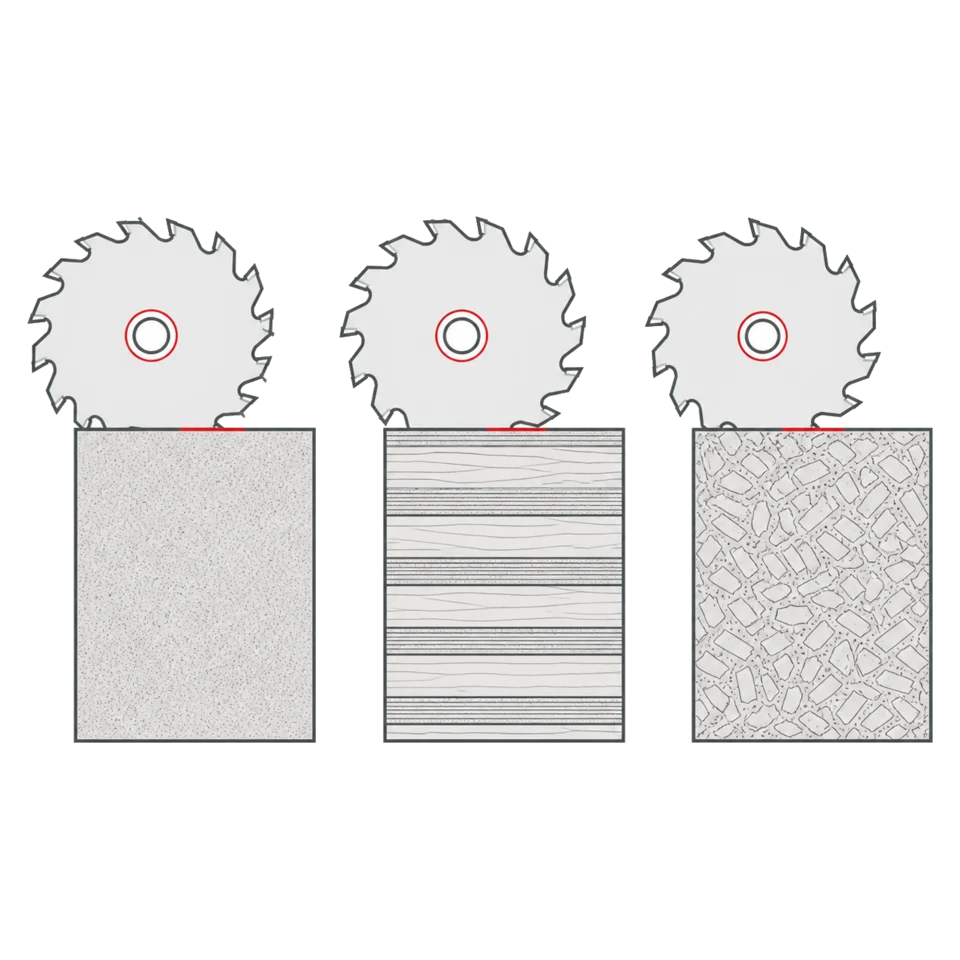
What each panel presents to the blade
All are wood-based panels, but the tooth meets three different structures.
| Panel | Structure at the tooth | Typical risk | Main requirement |
|---|---|---|---|
| MDF | Fine homogeneous fibres bonded with resin throughout | Fuzzy or burned edge and rapid wear | Fine tooth pitch and abrasion-resistant carbide |
| Plywood | Cross-laminated veneers with grain changing direction by layer | Tear-out in the exit veneer | An inclined cutting edge that severs fibres |
| Chipboard | Irregular particles with a high proportion of binder | Broken edge and irregular tooth wear | Medium tooth count with gullets able to evacuate dust |
This comparison applies to raw panels. With melamine or laminate surfacing, the coating becomes the primary selection factor.
Abrasiveness matters more than hardness
These boards are not hard in the same sense as dense exotic timber. They are abrasive: the edge becomes rounded rather than suddenly chipped. Quality can deteriorate so gradually that the change is noticed only by comparing current work with a piece cut weeks earlier.
Catalogue families respond through carbide grade. General panel families use grades such as H01K; finer-pitch families use H00K; blades for coated panels and industrial sizing use wear-oriented grades such as H00XA. These are different balances of hardness and toughness, not a simple quality ladder.
For raw board whose edge will be covered, prioritise useful life and a medium tooth count. Where the edge remains visible, finish becomes the constraint and more frequent sharpening may be accepted. Every choice involves a trade-off.
Raw and coated panel
Raw
Uncoated MDF, plywood or chipboard
- The main problem is fibre or particle structure; ATB usually severs it effectively
- Medium tooth counts, commonly Z36 to Z72 at 300 mm
- No scoring blade is normally required
- Wear is progressive and strongly influenced by binder
- General families such as LU2A and LU2B cover both cutting directions
Coated
Melamine-faced or laminated panel
- The thin brittle surface becomes the critical material
- Geometry must sever the coating before removing the substrate
- With scoring, a dedicated TCG family such as LU3D is used
- Without scoring, use a family expressly designed to work alone within its limits
- A higher tooth count does not replace a scoring blade
How far apart available tooth counts are
Which family for which panel
These families cover wood-based panels but their declared applications do not fully overlap.
| Family | Declared panels | Geometry and hook | Appropriate use |
|---|---|---|---|
| LU2A | Chipboard, plywood and MDF | ATB 10° or 15°, +15° hook | Mixed work in both directions, from 150 to 760 mm |
| LU2B | Chipboard, plywood and MDF | ATB 15°, +10° hook | The same field as LU2A with a finer edge and lower feed |
| LU2C | Chipboard, laminated MDF and thermoplastic composites | ATB 15°, +5° hook | Crosscutting only, when the edge remains visible |
| LU3A | Laminated chipboard, laminated MDF and plywood | ATB 38°, −5° to +5° by code | Two-sided laminates without scoring within the stated thickness range |
| LU3D | Chipboard and MDF, including laminated | TCG, +5° or +10° by code | Two-sided laminates with scoring on a squaring saw |
The family defines the technical design; the product code defines the orderable combination of diameter, bore, kerf and Z.
Estimate tooth count for your panel thickness
The manufacturer's formulas apply to wood composites and crosscutting. Enter the actual panel thickness and blade diameter.
The result is theoretical and rarely equals an available product code. Use it to identify the range: if the estimate is 111 and Z96 and Z120 exist, those are the real options to compare.
Common mistakes
-
Treating MDF like softwood
It feels easy to cut, but the resin continuously abrades the edge. In regular production, carbide grade can make weeks of difference to the service interval.
-
Using one blade interchangeably on plywood and chipboard
It is possible, but the wear mechanisms differ. Plywood alternates grain direction by layer; chipboard grinds particles and binder. If both are used, set service expectations from the more abrasive work.
-
Increasing tooth count on thick MDF
A very fine pitch in 30 mm MDF can create dust rather than chips, fill the gullets and darken the edge. More teeth can then worsen rather than improve finish.
-
Ignoring extraction
Fine MDF and chipboard dust remains in the cut when extraction is weak. Under those conditions, a medium tooth count can outperform a finer one because its gullets actually empty.
-
Choosing by substrate when the panel is coated
On a faced board, the coating chips. The key questions become whether the machine has a scorer and whether panel thickness falls within a no-scoring family's declared range.
Frequently asked questions
01 Does MDF require a different family from chipboard?
Not necessarily. LU2A and LU2B cover both. Tooth count within the family may change: MDF can accept a finer pitch, while medium Z on raw chipboard can last longer without sacrificing a hidden edge.
02 Why does plywood tear on only one face?
The veneers are cross-laminated and the exit veneer may have an unfavourable grain direction. Entry fibres are supported; exit fibres are not. A sacrificial backing sheet can substantially reduce tear-out.
03 How many teeth are needed for an 18 mm panel?
At 300 mm and for crosscutting, the cited formula gives about 111 teeth for roughly three engaged teeth. LU2C offers Z96 and Z120, so those are the real options. For a raw edge that will be covered, Z96 may be sufficient.
04 Is laminated MDF cut like raw MDF?
No. The surface becomes decisive. Use a family declared for laminated material and select according to whether the machine has a scoring unit.
05 Which carbide grade is suitable for panels?
It depends on the family and priority: H01K appears on general ranges, H00K on finer-pitch families and H00XA on coated-panel and industrial sizing blades. Use the manufacturer's declared material and application rather than grade alone.
06 Can chipboard be cut without a scoring blade?
Raw chipboard can. Laminated chipboard is different: some families work without scoring within a stated thickness range, but outside that range a scoring unit remains the reliable solution.
07 How can I recognise blade wear on these panels?
Quality deteriorates gradually. Rising feed force, a change in sound and slight darkening of the cut wall are useful indicators. Keep a sample cut with a new blade for comparison.
08 Does stack cutting change blade selection?
Yes. Three 18 mm panels create a 54 mm cutting thickness, so tooth-count estimation must use the complete stack rather than one panel.
Technical review
Filippo Perissinotto
Technical reviewer for wood and wood-based materials
Graduate in Wood Technology and Industries, technical consultant and wood-sector specialist.
The review covers the accuracy, clarity and consistency of information relating to wood and wood-based materials. Tool setup, machine operation and safety must always be checked against the manufacturer’s documentation and instructions.
Profile, qualifications and review methodRelated guides