Materials
Solid wood: grain direction and circular saw blade selection
At a glance
Solid wood has a directional structure: its grain. Ripping and crosscutting are different operations requiring opposite tooth-count strategies. Ripping needs few teeth and large gullets for long chips; crosscutting needs more teeth and an inclined edge that severs fibres before lifting them. Moisture, knots, resin and species density refine the choice.
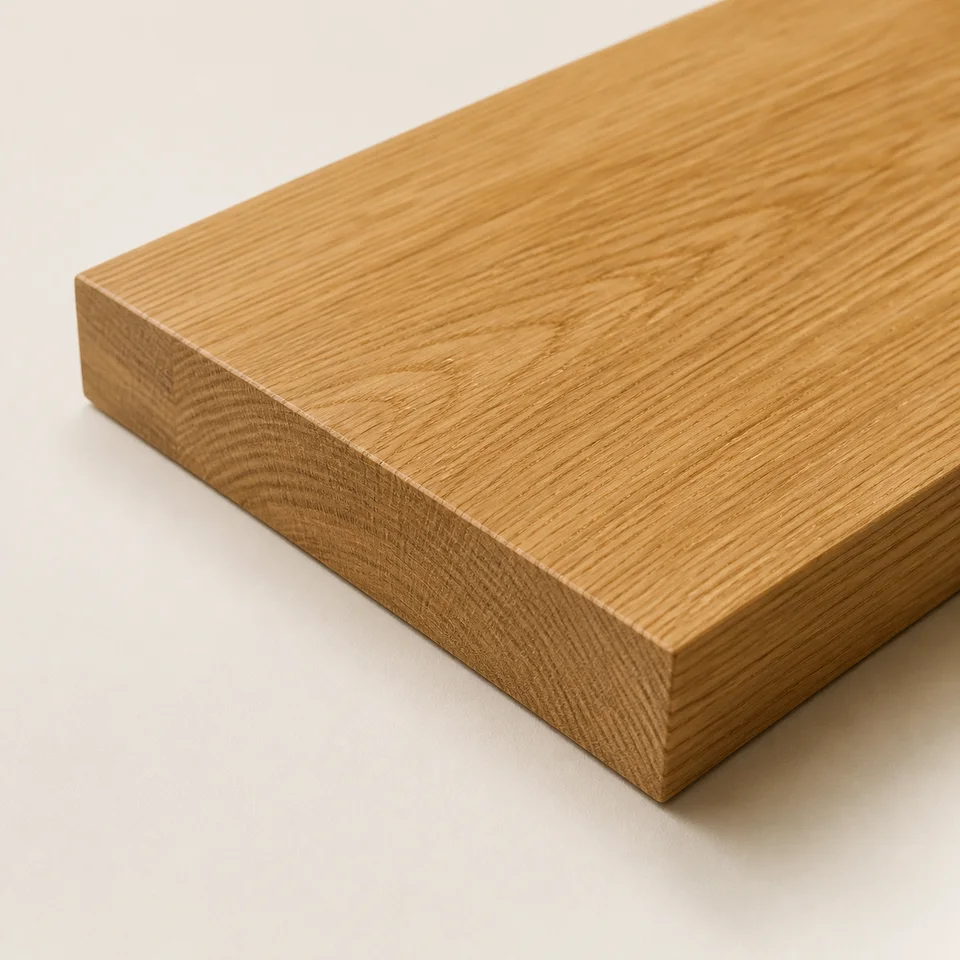
A material with a direction
Unlike reconstituted fibres, pressed particles or cross-laminated veneers, solid wood retains the tree's original structure: elongated cells aligned in one main direction and bonded by lignin.
It therefore has two distinct cutting behaviours. Along the grain the cells mainly separate and produce long stringy chips. Across the grain, each cell must be severed and fibres lift unless cut cleanly. Ripping and crosscutting are genuinely different operations.
Three variables add further complexity: moisture, because wet chips pack into gullets while very dry wood can burn; knots, where twisted grain and local density rise; and resins and extractives, which deposit on the blade and increase friction.
Softwood and hardwood are botanical categories—conifers and broadleaf species—not direct measures of cutting difficulty. Density, resin and abrasive mineral content are more useful practical indicators.
The two operations in practice
Ripping
The blade follows the grain
- Long bulky chips require large evacuation space
- Low tooth counts, commonly Z20 to Z30 at 300 mm
- A more positive hook assists feed
- The edge is naturally cleaner; productivity and heat are the constraints
- A full gullet causes rubbing and burning
Crosscutting
The blade crosses the grain
- Short fine chips make evacuation less critical
- Higher tooth counts, from around Z60 to beyond Z96 at 300 mm
- A modest hook helps avoid lifting fibres
- Exit-edge tear-out is the principal defect
- An inclined edge must sever fibres before pushing them
How far apart the tooth counts are
What changes between wood types
Botanical classification alone is insufficient. Density, resin and grain regularity determine what the tooth experiences.
| Wood type | Examples | Challenge | Approach |
|---|---|---|---|
| Resinous softwoods | Spruce, pine, larch | Low density but resin deposits on the plate | Low tooth count and frequent blade cleaning |
| Low-density hardwoods | Poplar, lime, alder | Soft fibres can fray at exit | A sharp edge and steady feed |
| Dense European hardwoods | Oak, beech, ash | High density and locally irregular grain | Tough carbide and a tooth count matched to thickness |
| Dense tropical woods | Iroko, teak, wenge | High density, silica and natural oils | Carbide grade strongly affects edge life |
| Wet or green timber | Any insufficiently seasoned species | Wet chips pack into gullets | Very large gullets and suitable stabilising teeth on multiripping machines |
| Knotty zones | Possible in every species | Twisted grain and locally high density | Maintain steady feed and never force through the knot |
A dense wood loads the machine; an abrasive wood wears the edge. These are different problems requiring different responses.
Moisture changes blade requirements
A blade intended for seasoned timber can burn when used on green wood because wet chips do not evacuate cleanly: they pack into the gullets, remain in the cut and create friction.
For unseasoned wood, reduce tooth count and use larger gullets rather than adding teeth. Dedicated multiripping families with stabilising teeth are designed for wet timber and represent a different tool configuration.
The ideal blade and setup for solid wood
Six checks in order. The first determines all the others.
-
Determine cutting direction first
Ripping needs fewer teeth and larger gullets; crosscutting needs more teeth and an inclined cutting edge. A universal family is a compromise where the same machine performs both without a blade change.
-
Choose tooth count from thickness, not species
Engaged-tooth calculations depend on the thickness crossed. Dedicated 300 mm ripping families use approximately Z20 to Z28 by design, not as a limitation.
-
Match gullet size to chip volume
The gullet stores the chip between entry and exit. It is decisive in wet wood, thick sections and all ripping. Suitable stabilising geometries help a multiripping blade remain aligned while clearing wet material.
-
Use ATB for crosscutting
An inclined ATB edge severs fibres instead of pushing them. For visible moulding edges, specialised high-bevel families can close the edge more effectively than universal blades.
-
Select carbide for the actual species and contaminants
H01K suits routine solid wood in declared families. Dense silica-rich tropical species and construction timber with possible foreign material call for the appropriately declared tougher grade, such as K10S on construction families.
-
Treat resin removal as maintenance
On resinous softwoods, deposits increase plate friction before the edge is dull. Clean according to the coating and manufacturer's instructions; avoid unsuitable caustic products.
Where these characteristics appear in the catalogue
These families declare solid wood but cover very different operations.
| Family | Geometry and carbide | Teeth at 300 mm | Appropriate use |
|---|---|---|---|
| LU1C | ATB, H01K | 26 | Reference family for ripping solid wood |
| LU1D | ATB, H01K | 28 | Ripping with a more refined edge |
| LU1E | Flat top, H01K | 24 and 28 | Thin-kerf ripping with less waste and power demand |
| LM04 | ATB with stabilising teeth, K10S | 24 | Multiripping machines where stability outweighs finish |
| LM05 | Flat top with stabilisers, K10S | 20 | Wet timber on multiripping machines with large chip space |
| LU1B | 45° bevelled tooth, K10S | 20 | Construction timber where foreign material may occur |
| LU1I | ATB 20°, H00K | 96 and 112 | Visible moulding and crosscut edges requiring high finish |
| LU2A | ATB 10° or 15°, H01K | 36 and 48 | Mixed solid wood and panel work in both directions |
| FRWPI | ATB, HW K05S | Not available | Solid wood with a hand-held site saw |
Common mistakes
-
Using a crosscut blade for ripping
A high tooth count has insufficient space for long ripping chips. Gullets fill, friction rises and the cut burns quickly.
-
Choosing tooth count from species hardness
The calculation uses thickness and engaged teeth. Oak and spruce of equal thickness can use similar Z; their sustainable feed and carbide-wear behaviour differ.
-
Forcing feed near a knot
Knots contain twisted grain and locally high density. Forcing the blade increases tip load and can damage carbide; maintain a controlled feed.
-
Ignoring resin until the cut deteriorates
Deposits grow before sharpness is lost. A blade that begins to require more feed force may need cleaning rather than resharpening.
-
Cutting green wood with a dry-timber blade
Wet chips pack into small gullets. Use a low tooth count, large gullets and a dedicated wet-timber multiripping family where applicable.
Frequently asked questions
01 Why does ripping require fewer teeth?
Ripping produces long bulky chips that must fit in the gullets until they leave the cut. Fewer teeth create larger gullets; it is a chip-volume requirement rather than a finish shortcut.
02 What is the cutting difference between softwood and hardwood?
The names are botanical rather than direct hardness ratings. Density determines machine load, while silica, oils and contaminants determine abrasion and edge life.
03 Which blade should I use if I cut in both directions?
Use a declared universal family and accept a compromise. If one direction dominates, a dedicated ripping or crosscutting family will give a better result.
04 Does wet wood require a different blade?
Yes. Wet chips pack into gullets, so use fewer teeth and larger evacuation space. Dedicated multiripping families with stabilising teeth are designed for unseasoned timber.
05 What are stabilising teeth?
They help keep a multiripping blade aligned in a stack rather than performing the primary cut. Stability can matter more than individual edge finish in that application.
06 Why do blades wear faster on tropical wood?
Many tropical species contain silica and oils that abrade or foul the cutting edge. Density loads the motor, but abrasive content is what directly shortens edge life.
07 How many teeth for crosscutting a 40 mm board?
The cited formula gives roughly 50 teeth for a 300 mm blade and about three engaged teeth. Use this as a range indicator, then choose the nearest available configuration and consider the required finish.
08 How often should a blade cutting resinous softwood be cleaned?
Inspect it before deposits noticeably impair the cut. Rising feed force without a corresponding loss of edge quality often indicates resin build-up rather than a dull edge.
Technical review
Filippo Perissinotto
Technical reviewer for wood and wood-based materials
Graduate in Wood Technology and Industries, technical consultant and wood-sector specialist.
The review covers the accuracy, clarity and consistency of information relating to wood and wood-based materials. Tool setup, machine operation and safety must always be checked against the manufacturer’s documentation and instructions.
Profile, qualifications and review methodRelated guides