Materials
Melamine-faced and two-sided laminated panels: blade selection
At a glance
When cutting melamine-faced or two-sided laminated board, the critical material is the hard brittle surface rather than the wood-based core. It tends to chip where the tooth exits. The reference solution uses geometry that scores the surface before removing the substrate—typically TCG with a scoring blade on a squaring saw—and a high tooth count with a modest or negative hook angle.
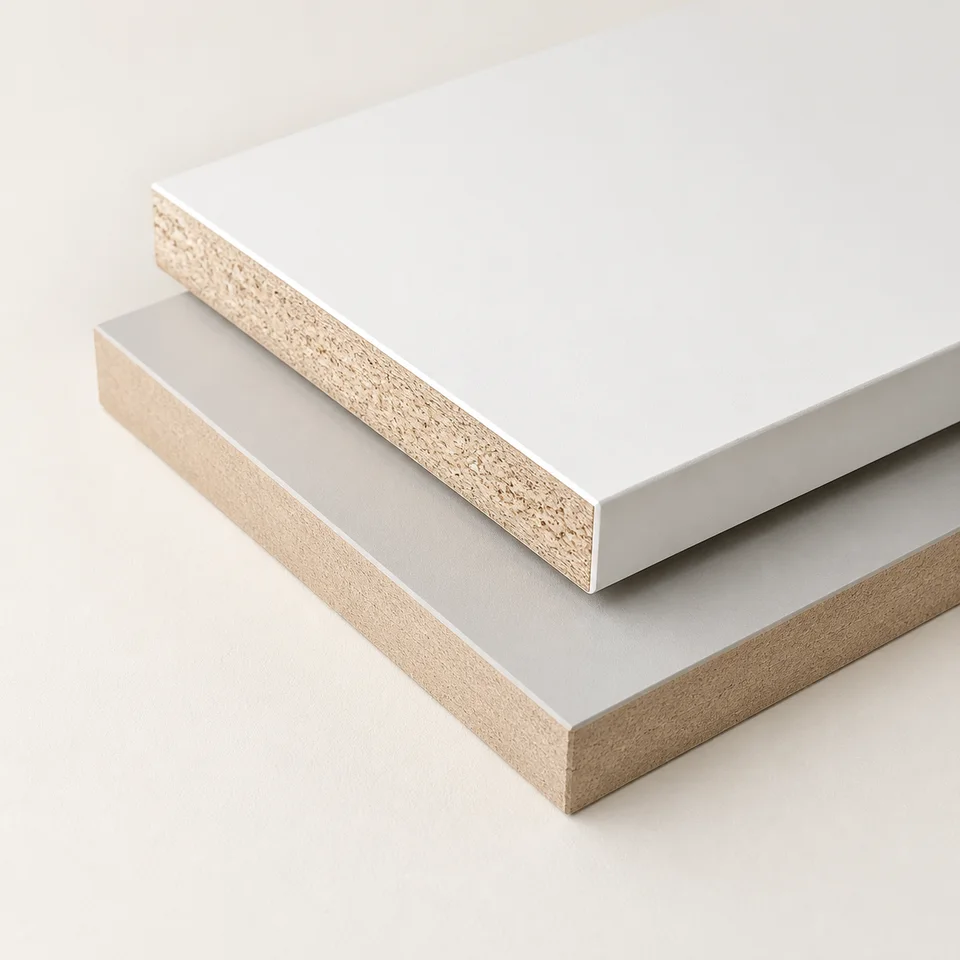
The entire problem is in the surface layer
A melamine-faced board is chipboard or MDF surfaced with resin-impregnated decorative paper under pressure. Two-sided laminated board applies the surface to both faces, and the term is also used more broadly for panels with bonded laminate. The substrate remains a familiar wood-based board.
The surface behaves differently. Cured resin-impregnated paper is hard and brittle, far more so than the substrate, and only fractions of a millimetre thick. It fractures rather than cutting like wood fibre.
On the entry side the surface is compressed against the substrate and remains supported. On the exit side the tooth pushes the coating outwards after the support has disappeared, breaking it into chips.
A blade that leaves a clean edge on raw chipboard can therefore fail on the faced version. The core has not changed; the requirement to sever the surface first has.
How a scoring unit works
-
The scoring blade cuts the lower surface
A small blade ahead of the main blade rotates in the opposite direction and opens a shallow groove in the lower face. Its width is matched to the main kerf.
-
The groove removes the exit edge
When the main blade arrives, that coating has already been severed. There is no unsupported layer left for it to tear away.
-
The main blade removes the substrate
It works within the pre-cut groove. TCG geometry also keeps the upper coating clean, where entry-side compression already assists the cut.
-
The two kerfs must be aligned
The score should equal or be only slightly wider than the main kerf. Too narrow and chipping returns; too wide and a visible step remains on the edge.
With and without a scoring blade
With a scoring blade
Equipped squaring and panel sizing saws
- Clean upper and lower edges across the intended panel thickness range
- The main blade uses TCG with a modest positive hook
- Scoring width must be calibrated whenever the main blade changes
- The reference solution for furniture production
- Dedicated faced-panel main and scoring families
Without a scoring blade
Unequipped machines and restricted thicknesses
- Lower-edge quality depends entirely on the main-blade geometry
- The family must be expressly designed to work alone
- The declared application is normally limited to thinner panels
- Steep bevels or negative hook are used according to spindle position
- A good result is possible but is not identical to a correctly set scoring system
Relevant tooth geometries
Here the geometry name describes exactly how the tooth meets the coating.
| Geometry | How it works | Application |
|---|---|---|
| TCG | A trapezoidal tooth roughs and protects the corner; a flat tooth clears the cut bottom | The standard for faced panels, with or without scoring where specified |
| ATB with steep bevel | The inclined tip scores the surface before the tooth body removes material | Thin faced panels without a scoring blade |
| Conical ATB | A conical profile opens a V-shaped groove whose width changes with blade height | Conical scoring blades |
| ATB on an adjustable scorer | Two adjacent blade halves whose spacing sets groove width | Adjustable scoring sets using calibrated spacers |
| Industrial flat/trapezoidal sequence | Alternates teeth with different angles to stabilise the cut | Industrial sizing of large-format panels |
Faced-panel blades generally use a modest or negative hook angle. A strongly positive angle tends to lift rather than sever the brittle coating.
The ideal blade for a faced panel
Five checks. Compared with raw board, geometry moves to the top of the list.
-
Triple-chip grind geometry
The trapezoidal tooth enters first and protects its corners; the lower flat tooth clears the bottom. Fine ATB alone does not reproduce the same action on a brittle surface.
-
A scoring blade where the machine provides one
On an equipped squaring or panel sizing saw it is the reference solution. At every blade change, check both scoring width against main kerf and alignment between the two cuts.
-
Modest or negative hook angle
Faced-panel families range approximately from −6° to +10° according to machine and spindle position. Negative values direct force towards the table and can allow specified thin panels to be cut without scoring.
-
High tooth count as a consequence, not the objective
At 300 mm these families commonly use Z72 to Z96. Geometry controls chipping; the high count distributes work and maintains a closed upper edge once the surface is correctly scored.
-
Carbide resistant to melamine abrasion
Cured melamine resin is more abrasive than the substrate. Dedicated families use grades such as H00XA and H00XF, selected for wear resistance and longer intervals between sharpenings.
Where these characteristics appear in the catalogue
These families all cover faced panels but address different operating conditions.
| Family | Geometry and hook | Teeth at 300 mm | Appropriate use |
|---|---|---|---|
| LU3D | TCG, +5° or +10° by code | 72–96 | Two-sided laminates on a squaring saw with scoring |
| LG3D | TCG, H00XA carbide | 72 and 96 | The same application in a more compact range |
| LU3A | ATB 38°, −5° to +5° | 96 | Faced panels without scoring within the declared thickness range |
| LU3E | TCG, −6° | 72 | Thicker two-sided laminates with force directed towards the table |
| LU3F | TCG, −3° | 96 | Two-sided laminates and plastic materials |
| LU2C | ATB, H00K carbide | 96 and 120 | Crosscutting faced panels where fine ATB is sufficient |
| LI25M | Conical ATB | Not applicable | Conical scorers adjusted by height |
| LI16M | ATB adjustable scoring set | Not applicable | Width adjusted with calibrated spacers |
| LSBX | Flat/trapezoidal sequence, variable angles | 60–96 | Industrial sizing of large-format panels |
| FRLPI | ATB, −5°, HW H00K | Not available | Faced panels with a hand-held or plunge saw |
Common mistakes
-
Using the raw-panel blade because the substrate is identical
The substrate is the same, but the surface must be severed first. A general ATB blade can lift the exit-side coating and leave chipping that slower feed cannot correct.
-
Failing to recalibrate the scoring blade
A score narrower than the main kerf behaves almost as if no scorer were present; one that is too wide leaves a step. This is a frequent cause of chipping on equipped machines.
-
Expecting one blade to equal a scoring system
Families designed to work alone have a declared field, generally limited by panel thickness. Exceeding it means working outside the intended conditions.
-
Adding teeth instead of changing geometry
A higher Z may reduce chipping slightly but does not remove its mechanism; it also reduces chip space and adds heat. The major improvement comes from geometry and scoring.
-
Ignoring melamine abrasion
The surface wears the edge faster than raw chipboard. Resharpening intervals based on uncoated panels allow edge quality to deteriorate too far before service.
Frequently asked questions
01 Why does the coating chip on only one side?
On the entry side it is compressed against the substrate; on the exit side the tooth pushes it outward without support. On a table saw the exit face is normally below, while on a hand-held saw it is normally above.
02 Is a scoring blade essential?
On a machine equipped for one it is the reference solution. Families designed to work without scoring can give good results within a limited declared thickness range, but are not universally equivalent.
03 How is scoring width adjusted?
A conical scorer changes width as blade height changes. A two-part adjustable scorer changes width through calibrated spacing between its halves. In both cases match it to the main blade kerf.
04 What is the difference between melamine-faced and laminated board?
Melamine-faced board uses resin-impregnated paper pressed onto the substrate. Bonded laminate is generally thicker and harder. The cutting mechanism is similar, but laminate is more demanding on both edge quality and tool wear.
05 Which hook angle is appropriate?
A modest or negative angle. Dedicated families span roughly −6° to +10° according to machine and spindle position. Negative hook directs pressure towards the worktable.
06 Why are tooth counts so high?
Not to eliminate chipping—that is geometry's role—but to share the load and keep the entry edge closed. At 300 mm, Z72 to Z96 is common; unnecessary additional teeth reduce gullet space.
07 Does faced board wear a blade faster than raw board?
Yes. Cured melamine resin is more abrasive than the substrate, which is why dedicated families use wear-oriented carbide grades such as H00XA and H00XF.
08 Can faced panels be cut with a hand-held saw?
Yes, with a family designed for that use. Place the visible face on the entry side—normally underneath with a hand-held circular saw—and support the panel correctly.
Technical review
Filippo Perissinotto
Technical reviewer for wood and wood-based materials
Graduate in Wood Technology and Industries, technical consultant and wood-sector specialist.
The review covers the accuracy, clarity and consistency of information relating to wood and wood-based materials. Tool setup, machine operation and safety must always be checked against the manufacturer’s documentation and instructions.
Profile, qualifications and review methodRelated guides