Materials
Aluminium: how to choose a circular saw blade
At a glance
Aluminium is soft, ductile and highly conductive. Beneath the tooth it deforms rather than fractures and can weld itself to the cutting edge. A suitable blade uses triple-chip geometry to break the chip, a zero or negative hook angle for profiles, a high tooth count and a moderate kerf. Using a wood blade on an aluminium profile is dangerous, not merely unsuitable.
Soft does not mean easy
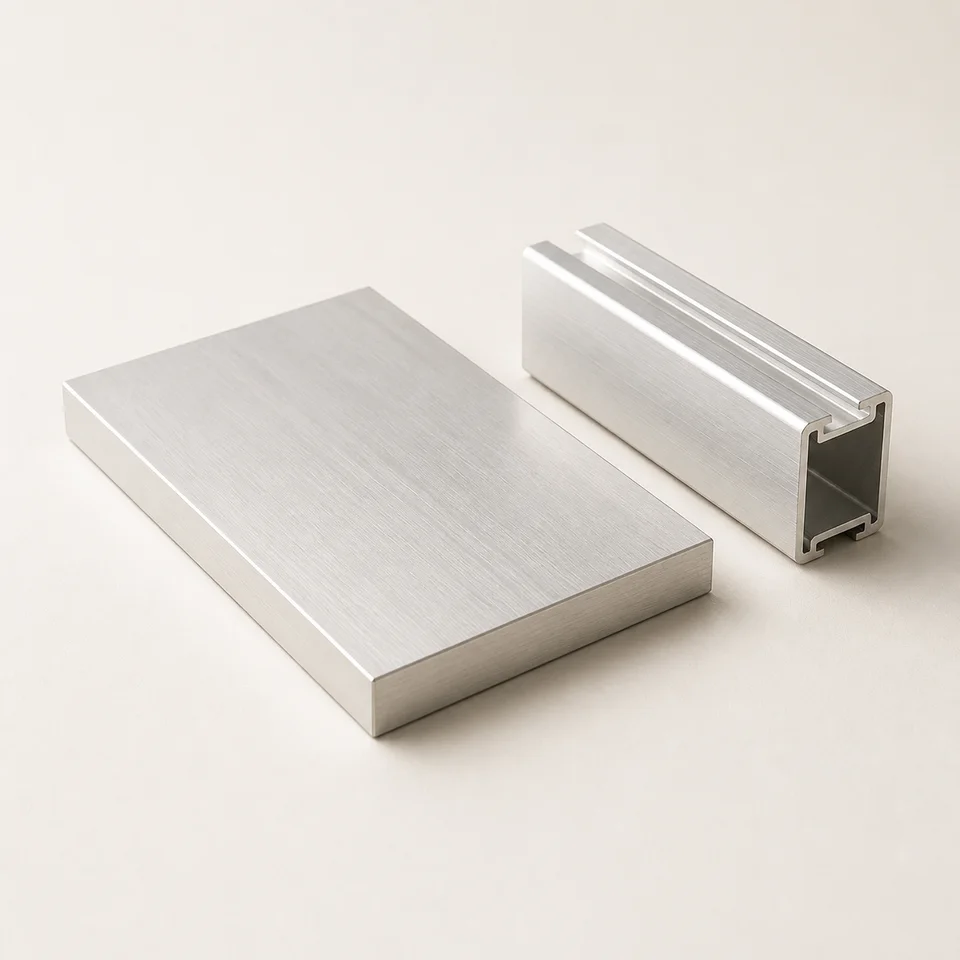
Aluminium combines low weight, corrosion resistance and easy extrusion. The same properties that make it convenient to manufacture also make it demanding to saw.
Wood fibres fracture and separate under a tooth. Aluminium is ductile: it plastically deforms, producing a curling chip that can remain against the cutting edge. Because aluminium conducts heat well and softens more readily than many metals, a hot cutting edge can make it adhere and form a built-up edge.
The process then accelerates. The tooth cuts with adhered metal rather than its designed profile, friction increases, the deposit grows and the edge becomes scored. Unlike gradual abrasive wear, built-up edge can worsen rapidly once it begins.
Hollow profiles add a safety issue. Their thin walls and low mass allow the tooth to grab, lift and rotate the workpiece. Hook angle is therefore a functional requirement, not a preference.
Different aluminium sections need different setups
The decisive measurement is the wall thickness crossed by the tooth.
| Workpiece | Typical wall thickness | Main risk | Requirement |
|---|---|---|---|
| Hollow profiles and tube | 1–3 mm | The tooth grabs the wall and lifts the workpiece | Very fine tooth pitch and negative hook |
| Structural profiles | 3–6 mm | Chip adhesion and built-up edge | TCG geometry and suitable lubrication |
| Solid bars and thick plate | Over 6 mm | Accumulated heat and workpiece distortion | Fewer teeth and larger gullets |
| Thin sheet | Below 1.5 mm | Vibration and a rippled edge | Rigid support and a thin kerf |
| Plastic-core composites | Variable | The tooth crosses layers of different hardness | Neutral geometry around 0° |
Choose tooth count from the thickness being crossed, not the profile's external dimensions.
Never fit a wood blade to an aluminium profile
A wood blade typically has fewer teeth and a strongly positive hook angle intended to pull into the material. On a hollow aluminium profile, that combination can grab the wall, lift and rotate the workpiece and potentially project it.
Check that the blade is declared for non-ferrous metals, that machine speed remains within the value marked on the blade and that the workpiece is clamped rather than merely supported.
How fine an aluminium blade tooth pitch is
The ideal aluminium cutting setup
Six checks. The first two are mandatory and the others cannot compensate for them.
-
Zero or negative hook angle
A negative hook directs force towards the table rather than lifting the workpiece. Non-ferrous families range from −6° to +10° according to application: positive values suit solid sections, while hollow profiles generally require zero or negative angles.
-
Triple-chip rather than alternating-bevel geometry
TCG, also identified as HLTCG in the catalogue, alternates a trapezoidal roughing tooth with a flat clearing tooth. It breaks the chip into shorter sections rather than allowing it to curl continuously.
-
Fine tooth pitch selected from wall thickness
Thin walls require several teeth engaged at once. Non-ferrous families reach Z96 at 300 mm and higher counts at larger diameters. Solid sections use fewer teeth to provide chip space.
-
Moderate kerf
Removing less material produces less heat and fewer chips. Portable and cordless families therefore use thinner kerfs than many corresponding wood blades.
-
Carbide and coating intended for non-ferrous metals
Industrial aluminium families use grades such as H01K; portable families combine appropriate carbide with a low-friction coating. The coating reduces adhesion to the blade plate and helps delay built-up edge.
-
Suitable lubrication and rigid clamping
A light application of an approved lubricant can reduce friction and built-up edge. Support and clamp the profile near the cutting line to prevent vibration, edge scoring and grabbing.
Where these characteristics appear in the catalogue
The following families declare aluminium and other non-ferrous metals among their applications.
| Family | Geometry and hook | Teeth at 300 mm | Appropriate use |
|---|---|---|---|
| LU5A | TCG, +10° | 72 | Extrusions and profiles on industrial machines |
| LU5B | TCG, +5° | 88 and 96 | A broad range for non-ferrous metals and plastics |
| LU5C | TCG, −6° | 72 | Sections over 3 mm where the workpiece must be restrained |
| LU5D | TCG, −6° | 96 | Tubes and hollow profiles |
| FRAPI | HLTCG, −5° | Not available | Aluminium on hand-held or plunge saws |
| FRAT | HLTCG, −5° | 96 | Profiles on a mitre saw |
| FRABC | HLTCG, −5° | Not available | Aluminium on compact table saws |
| FRMPI | HLTCG with second-tooth bevel, 0° | Not available | Mixed construction work alternating aluminium and wood |
Portable cordless families use approximately 0° hook and thinner kerfs: less material removal means lower power demand and more cuts per charge.
Common mistakes
-
Increasing rpm to improve finish
More peripheral speed generates more heat and encourages chip welding. Remain within the marked limit and use a speed appropriate to the blade, machine and section.
-
Cutting a hollow profile without clamping it
An unsupported tube vibrates and can rotate if grabbed by a tooth. Preparation can matter more than small differences between suitable blade families.
-
Using a solid-section tooth count on thin profiles
A coarse pitch on a 2 mm wall creates intermittent engagement, vibration and a rippled edge, and increases the possibility of grabbing.
-
Ignoring built-up edge until it becomes obvious
Aluminium begins adhering before edge quality visibly collapses. Inspect and clean the teeth in accordance with the manufacturer's instructions before assuming that resharpening is required.
-
Omitting lubrication because dry cutting is possible
Dry cutting places greater demands on geometry, feed and surface condition. Where blade and machine instructions permit it, a suitable minimal lubricant can noticeably improve edge life and finish.
Frequently asked questions
01 Why does aluminium stick to the tooth?
It is ductile and highly conductive. The chip deforms and curls against a hot cutting edge; once it softens it can weld to the carbide, forming a built-up edge that progressively worsens the cut.
02 Is a negative hook angle really necessary?
For hollow profiles it is an important safety and quality requirement because it reduces the tendency to lift the workpiece. Solid bars and thick plate can use modest positive angles where the mass restrains the cut.
03 Can I use a wood blade for one quick aluminium cut?
No. A low tooth count and strongly positive hook are precisely the combination that can grab a profile. Use a blade declared for non-ferrous metals and a suitable machine setup.
04 How many teeth are needed for a profile with a 2 mm wall?
A fine pitch is required so several teeth remain engaged. Select the finest suitable tooth count offered at the machine's diameter; non-ferrous families commonly reach Z96 and above.
05 Should aluminium cutting be lubricated?
Where machine and blade instructions permit it, a light application of suitable lubricant usually helps. It reduces friction, edge temperature and built-up edge.
06 Are copper and brass cut with the same blades?
The same non-ferrous families and geometric principles apply, but these materials have different density and thermal behaviour. Adjust feed and inspect the edge more frequently.
07 Why do cordless aluminium blades use 0° rather than a negative hook?
Cordless machines have limited stored energy. Approximately zero hook and a thin kerf reduce motor load while still avoiding the aggressive grabbing action of a strongly positive hook.
08 The edge is scored: what should I inspect?
First inspect for aluminium welded to the teeth, then check workpiece clamping and rotational speed. These are common causes, and built-up edge is easily missed without close inspection.
Technical review
Filippo Perissinotto
Technical reviewer for wood and wood-based materials
Graduate in Wood Technology and Industries, technical consultant and wood-sector specialist.
The review covers the accuracy, clarity and consistency of information relating to wood and wood-based materials. Tool setup, machine operation and safety must always be checked against the manufacturer’s documentation and instructions.
Profile, qualifications and review methodRelated guides