Materials
Fibre cement and plasterboard: how to choose a blade
At a glance
Fibre cement is a fibre-reinforced cementitious composite; plasterboard is a gypsum core between paper liners. Neither is especially hard, but both contain abrasive minerals. Suitable blades use polycrystalline diamond rather than conventional carbide, very low tooth counts—often four to eight—and large gullets to evacuate fine dust.
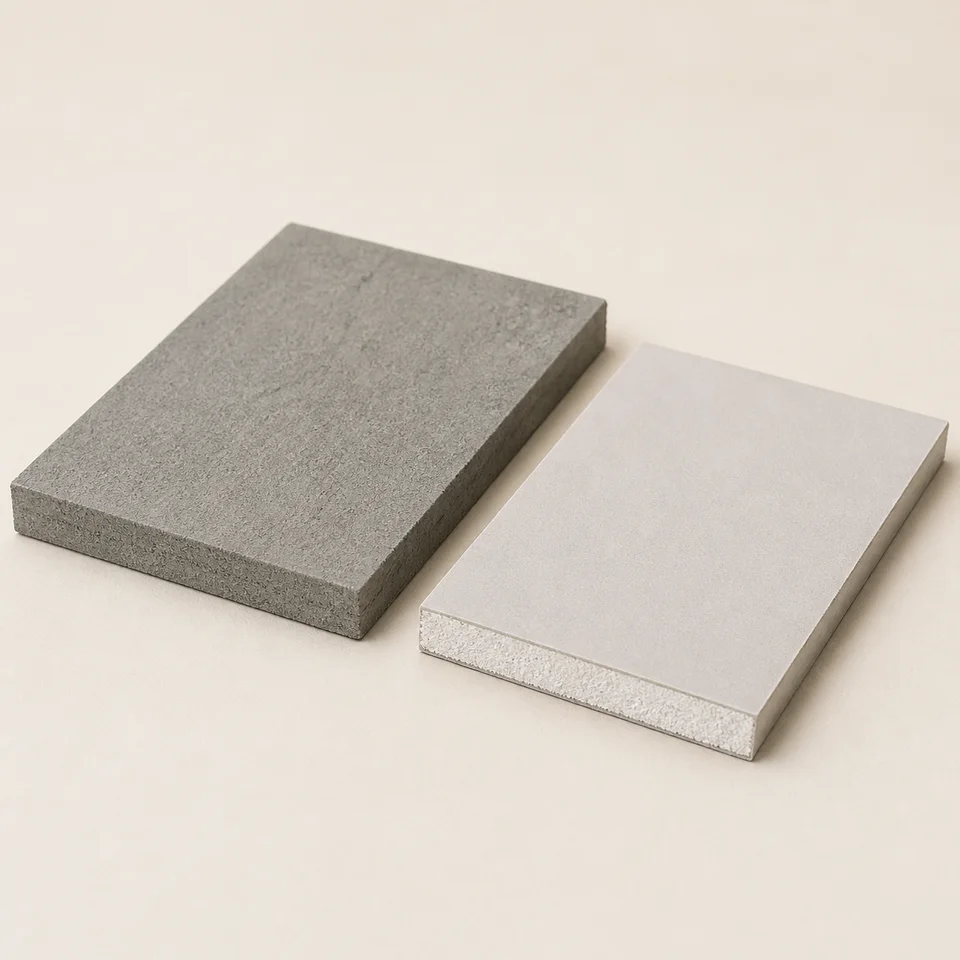
Easy to penetrate, severe on the cutting edge
Fibre cement is a cementitious composite containing cement, mineral fillers and reinforcing cellulose or synthetic fibres. It is used for roofing sheets, ventilated façades and cladding where water resistance and dimensional stability are required.
Plasterboard consists of a compacted gypsum core between paper liners. Water-resistant, fire-resistant and high-density variants change the additives and liners but retain the same basic construction.
Both can feel deceptively easy to cut because the machine meets little resistance. The difficulty is their mineral composition. Cement, siliceous fillers and gypsum abrade the cutting edge like fine sand.
Conventional carbide therefore loses sharpness quickly. It may not chip or break; it is gradually polished away. This is why dedicated families change the tooth-tip material itself.
Why diamond, and why so few teeth
Dedicated blades use polycrystalline diamond, marked DP or PCD. It is a sintered diamond material with far greater abrasion resistance than carbide and substantially changes achievable tool life on mineral materials.
PCD is expensive and can be vulnerable to impact, so dedicated blades use few purpose-designed teeth. Four or six teeth on a diameter that might carry forty on a wood blade is entirely normal.
The low count also creates very large gullets. Fibre cement and plasterboard produce fine dry dust that can pack into small spaces; large gullets help carry it out rather than recirculating it against the blade.
A positive 10° hook angle across these families assists entry into the low-resistance material and helps direct debris away from the slot.
Dust is the principal hazard
Cutting fibre cement can release fine mineral dust containing respirable crystalline silica. Control it in accordance with the product's safety data and local regulations: use effective extraction, suitable respiratory protection and approved wet-cutting or outdoor methods where applicable.
Plasterboard dust is generally less hazardous but is highly invasive, loads filters and returns to the cut if not extracted, increasing friction and wear.
Never cut old or unidentified cement sheet until it has been confirmed not to contain asbestos. Suspected asbestos-containing material requires specialist identification and legally compliant handling.
How the two materials differ
They use the same blade families but do not present identical problems.
| Aspect | Fibre cement | Plasterboard |
|---|---|---|
| Structure | Fibre-reinforced cementitious matrix | Gypsum core between paper liners |
| Abrasive component | Cement and siliceous fillers | Gypsum and mineral additives |
| Typical cut defect | Exit-edge chipping | Torn surface paper |
| Dust | Fine mineral dust that may contain crystalline silica | Fine, high-volume gypsum dust |
| Main precaution | Support the sheet and use effective dust control | Orient the paper correctly and maintain a continuous cut |
| Expected edge life | Low with carbide, much higher with suitable PCD | Low with carbide, much higher with suitable PCD |
Catalogue families for this application declare both fibre cement and plasterboard.
The ideal blade and setup
Five checks. The first separates a suitable blade from one that can wear out within a day.
-
Polycrystalline diamond teeth
PCD offers abrasion resistance that conventional carbide cannot approach on mineral boards. Its higher initial cost should be evaluated against metres cut and downtime, not purchase price alone.
-
Very low tooth counts, from four to eight
Portable-saw families commonly have four or six teeth, increasing to eight on some mitre-saw diameters. Here tooth count governs dust evacuation rather than fibre finish, so large gullets are essential.
-
Positive hook angle
The range uses a positive 10° angle. It assists entry into a low-resistance material and helps direct dust out of the cut.
-
Thin kerf on cordless machines
Removing less material reduces both motor load and dust generation. Cordless families therefore use a thinner kerf than their corded counterparts.
-
Effective extraction and supported sheet
Extraction keeps dust out of the cut, while support close to the cutting line prevents fragile exit edges breaking away. Both influence result and safety as much as blade choice.
Dedicated catalogue families
The four families differ primarily by machine type and power source.
| Family | Machine | Teeth | Appropriate use |
|---|---|---|---|
| FRFPI | Corded hand-held and plunge saws | 4 and 6 | Common site work from thin sheet to thicker board |
| FRFPIB | Cordless hand-held and plunge saws | 4 | The same application with a reduced kerf for battery power |
| FRFT | Corded mitre saws | 6 and 8 | Repeated sizing cuts on sheet and strips |
| FRFTB | Cordless mitre saws | 6 and 8 | The same site application without mains power |
All four use polycrystalline diamond teeth with TCG geometry and a positive 10° hook angle.
Common mistakes
-
Using a wood blade because the material feels soft
Low cutting resistance is misleading. Mineral content polishes carbide away, making a conventional blade expensive per metre even if it continues to cut for a while.
-
Assuming few teeth produce a rough cut
There is no wood fibre to sever or decorative coating to score. Four large-gullet teeth can leave a better edge than forty small-gullet teeth because dust is evacuated rather than recirculated.
-
Cutting without extraction because the task is brief
Respirable silica risk is not eliminated by a short cut. Uncontrolled dust also returns to the kerf and accelerates wear.
-
Failing to support the exit side
These boards are brittle. Without support near the cutting line, the exit edge can break away—a setup problem often blamed on the blade.
-
Cutting unidentified old sheets
Older sheets may contain asbestos. They must be identified and managed under applicable regulations, not cut experimentally.
Frequently asked questions
01 Why are diamond blades required for fibre cement?
Cement and siliceous fillers are highly abrasive and polish conventional carbide quickly. PCD is much more abrasion-resistant and can increase useful tool life by an order of magnitude in the intended application.
02 Are four teeth really enough?
Yes. These materials have no wood fibre or fragile laminate to score. Large gullets created by a low tooth count evacuate dust more effectively and can produce a cooler, cleaner cut.
03 Can the same blade cut fibre cement and plasterboard?
Yes. The dedicated catalogue families declare both materials because they share the central issues of mineral abrasion and fine-dust evacuation.
04 What changes between corded and cordless versions?
Primarily kerf. Cordless blades remove less material, reducing motor load and dust generation and extending battery runtime.
05 How can exit-edge chipping in fibre cement be reduced?
Support the sheet close to the cutting line and maintain a continuous feed. The defect often results from an unsupported brittle edge rather than blade geometry alone.
06 Can PCD teeth be resharpened?
Yes, but PCD requires specialist equipment and is not a general workshop grinding operation. Send it to a service centre equipped for polycrystalline diamond.
07 Should fibre cement be wet cut?
Wet methods can suppress dust effectively, but must be compatible with the electrical machine and manufacturer instructions. Otherwise use appropriately designed extraction and respiratory protection in accordance with the product safety data and regulations.
08 Can plasterboard be cut without a circular saw?
Yes. The traditional method is to score the paper with a knife and snap the board. A circular saw is useful for repeated, precise or non-straight cuts, but creates significant dust that must be controlled.
Technical review
Filippo Perissinotto
Technical reviewer for wood and wood-based materials
Graduate in Wood Technology and Industries, technical consultant and wood-sector specialist.
The review covers the accuracy, clarity and consistency of information relating to wood and wood-based materials. Tool setup, machine operation and safety must always be checked against the manufacturer’s documentation and instructions.
Profile, qualifications and review methodRelated guides